Agastya — Part 1 Pot, Debt and "Vatapi Jirono Bhava"
Agastya
વાતાપિ જીર્ણો ભવ
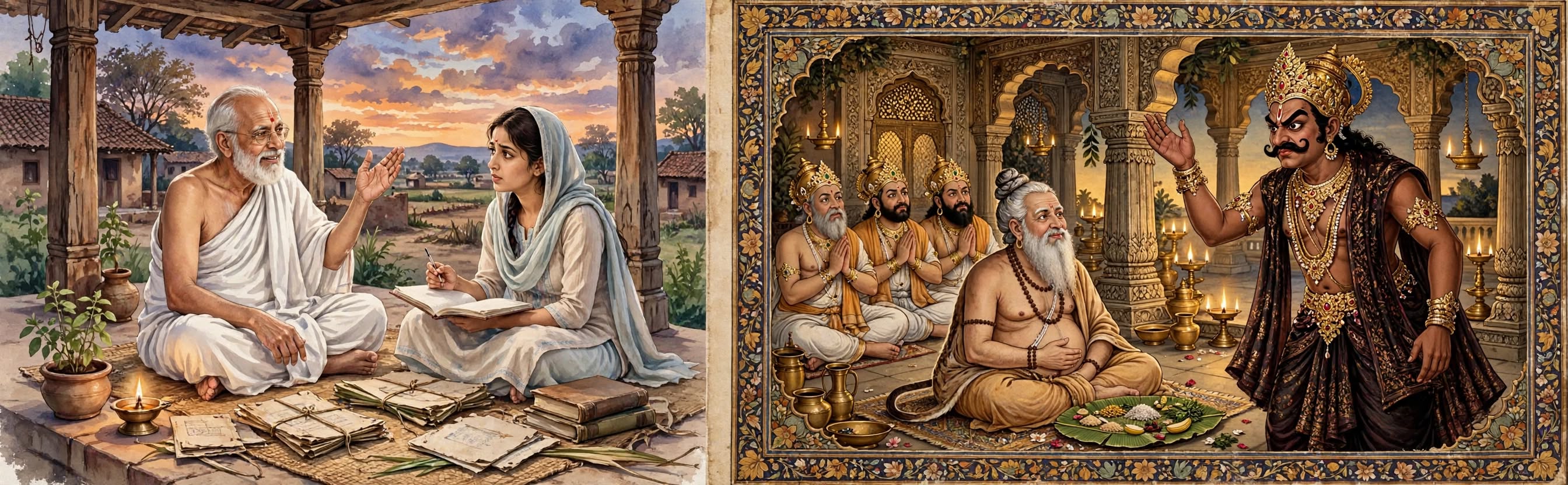
Introduction It was an evening of the Sharad season (autumn). The lamp for twilight had been lit in a small Vedic school situated on the riverbank. Acharya Agastya was seated on the veranda. Seated opposite him was Apala, a female disciple pursuing her postgraduate studies in Sanskrit. Shortly before, everyone had dined together at the school. After the meal, Acharya-ji had gently rubbed his abdomen and said "Vatapi jirno bhava" ([[May Vatapi be digested]]), and a question had been playing in Apala's mind ever since. Apala: Acharya-ji, may I ask you something? My grandmother also used to say "Vatapi jirno bhava" after meals. I never asked what it meant. And today another thing also came to my notice. Your name is Agastya, and this phrase also belongs to Sage Agastya, doesn't it? Acharya: (Smiling) Yes, child. My name was kept by my father in remembrance of the sage, just as your parents kept your name after the female seer Apala, who is the visionary (seer) of the ninety-first hymn of the eighth mandala of the Rigveda. So today, two namesakes will meet and talk about two sages, Agastya and Lopamudra, but there is one condition. Apala: What is it? Acharya: You will not just listen. Wherever a point does not go down your throat (make sense), ask questions, raise doubts. Our Upanishads were created in this very way. Nachiketa questioned Yama, Gargi challenged Yajnavalkya in a full assembly, and Arjuna asked questions in the middle of the battlefield, resulting in the creation of the great Gita. That is to say, without questions, knowledge remains merely information. Apala: Then the very first question is this, Acharya-ji. Are these stories true, or just tales? Acharya: A wonderful start. Yaskacharya's Nirukta shows the tradition of interpreting the Vedas on three levels: Adhibhautika, meaning related to this world and the body; Adhidaivika, meaning related to the forces of nature, the skies, and the seasons; and Adhyatmika, meaning related to the mind and the soul. These stories are tales on one level, an almanac of the heavens on the second level, and a map of the mind on the third level. Today, let us see how all three of these are hidden within the very same story.
Question 1: How is it possible to be born from a pot? Acharya: Let us begin with the birth of the sage. In the Rigveda, Mandala 7, Sukta 33, verses 10 to 13, a strange account appears. The vital energy (tejas) of the gods Mitra and Varuna fell into a sacrificial pot upon the sight of Urvashi. From that pot, two sages were born: Vashistha and Agastya. Later, this story is detailed in the Matsya Purana and Shaunaka's Brihaddevata. Apala: Acharya-ji, can a human being be born from a pot? This is impossible. Acharya: If taken literally, it is indeed impossible. But first, consider who Mitra and Varuna are. Mitra represents day, sunlight, and friendship. Varuna represents night, water, and Rita, the cosmic order. Now tell me, what is a pot used for? Apala: For storing water. Acharya: So what does this story tell us? The sage who is born from the union of light and water, from a vessel of water, his entire life story becomes a story of water. Agastya drinks the ocean. In the southern tradition, he keeps the Kaveri river in his kamandalu (water pot). And as a star in the sky, he purifies the waters after the monsoon. We shall see all of that on the third day. Apala: So the name [[કુંભયોનિ]] ([[Kumbhayoni]] - born from a pot) itself is a clue. Acharya: Exactly. And look at another clue as well. There are twenty-seven hymns by Agastya in the Rigveda, from Mandalas 165 to 191 in the first book. Twenty-one of those hymns conclude with the exact same prayer: may every community receive food and living water. He whose birth took place from a water vessel, his prayer is also about water. Apala: And what is the meaning of the name [[અગસ્ત્ય]] ([[Agastya]])? Acharya: A folk etymology is found in the Ayodhya Kanda of the Valmiki Ramayana. [[અગ]] ([[Ag]]) means a mountain, which is immovable, and [[ગમ્]] ([[Gam]]) means movement. Thus, Agastya means one who moves even the immovable. He made the Vindhya mountain bow down; that story is embedded within the name itself. (According to classical grammar, the etymology might be different, but the narrative tradition has chosen this meaning, and that is what matters.)
Question 2: Why were the ancestors hanging upside down? Acharya: Now, the original story. It is in the Vana Parva of the Mahabharata, in the Tirtha Yatra Parva, from chapters 96 to 99. During their exile, the Pandavas go on a pilgrimage, and Sage Lomash narrates this story to Yudhishthira. Thus, we are listening to the very same thing that Yudhishthira heard thousands of years ago. Agastya was an ascetic; one day, in a forest, he saw some old men hanging upside down in a pit with their heads down and feet up. When asked, the old men said, "We are your ancestors. Until you produce offspring, this will be our plight." Apala: Acharya ji, I have an objection here. The sage was meditating, he was not harming anyone. Then why the punishment to the ancestors? And how appropriate is it considered today that ancestors suffer if there is no offspring? Acharya: Your objection is valid, and that is why one must look at the esoteric meaning. The Taittiriya Samhita and Shatapatha Brahmana speak of three debts. A man is born bearing the debt to the gods (devrina), the debt to the sages (rishirina), and the debt to the ancestors (pitৃrina). What is the deep meaning of pitৃrina? It is to pass on what we received from our ancestors—life, language, knowledge, culture—to the next generation. Now look at the imagery of hanging upside down. The roots of a tree are at the bottom, and the fruits are at the top. If the flow stops, if the seed is not sown further, the entire tree becomes inverted. No matter how great a lone practitioner becomes, if knowledge ends with him, the tradition hangs upside down. Apala: Does that mean "offspring" is not just a son, but can also be an heir to knowledge? Acharya: You said it yourself. In the tradition of our sages, a disciple is also considered offspring. The guru-tradition itself is called a "lineage" (vamsa). Yet, the story does not reject household life. In this story, the ascetic sage also fulfills his duty as a householder. The discussion of that balance will come up next.
Question 3: Was Lopamudra "created"? Acharya: Agastya gave his word, but he did not see any woman suitable for himself. Therefore, the Vanaparva says that he took the most beautiful part from every creature of creation, such as the eyes of a deer, and created a maiden from them. He sent her to be born in the house of King Vidarbha, who was performing austerities for offspring. The Brahmins named her Lopamudra. Apala: (Closing her notebook) Acharya-ji, this story bothers me. A man "makes" a wife for himself, as if she were an object. And her name is also based on beauty? Is Lopamudra's identity only that? Acharya: (Becoming serious) It is necessary to ask this question, Apala. And the answer is in two parts. First part: Look at the word "Lop-mudra" (lop - disappearance, mudra - impression). Lop means to disappear, mudra means an impression, a seal. The traditional meaning is that in front of her beauty, the beauty of others would disappear. But from a Tantric perspective, a deep meaning can be considered: a consciousness in which all individual impressions melt away. This is my and the Tantric tradition's interpretation, not the literal word of the text. Remember that distinction. And the meaning of "a part from every creature of creation" also implies that female power is the essence of the entire creation. This very thought later developed into the form of the Goddess in the Shakta tradition. There, the Goddess manifests from the brilliance of every god. Second part, and it is more important: Lopamudra's identity is not beauty. She is a mantra-seer (composer of hymns) rishika of the Rigveda. The first two mantras of the 179th hymn of the first mandala are hers. And an entire tradition of Srividya runs in her name. Tomorrow's entire day has been set aside for that matter. Apala: So the way the Mahabharata depicts her is an incomplete picture? Acharya: A complete picture of a person is not obtained from a single text. But read carefully even in the Mahabharata; in what happens next, Lopamudra is not only beautiful, she is also intelligent. Come, let's see.
Question 4: Why would a female seer ask for jewelry? Acharya: Lopamudra came of age, and Agastya asked the King of Vidarbha for her hand in marriage. The king was perplexed. On one side was a daughter raised in a palace, and on the other was a bark-garbed ascetic. If he refused, he feared a curse. At that moment, Lopamudra made her own decision: "Father, hand me over to the Maharshi." After marriage, she discarded her silk garments, donned tree bark, and performed austerities just as severe as her husband's at Gangadvara, which is today's Haridwar. This is found in the 97th chapter of the Vanaparva. And in the 130th chapter, there is a brief note that their wedding took place at Mahasindhutirtha. Years later, Agastya called her to him. At that time, Lopamudra put forward a condition: "Only when there is a bed like my father's palace, and both you and I are adorned with ornaments, shall it be so." Apala: (Laughing) Acharya ji, this is a complete contradiction! A woman who left a royal palace, performed austerities for years—does she ask for jewelry? And you call her a rishika (female seer)? Acharya: Your laughter is justified, but listen to the reason for the condition. Lopamudra said, "I do not wish to defile these sacred bark garments of austerity with worldly enjoyment." Apala: Oh... Acharya: Now listen to the ensuing dialogue. Agastya said, "By the power of my austerities, I can generate wealth, but doing so would diminish my ascetic power." And Lopamudra replied, "Then acquire wealth in such a way that the austerities are not destroyed." Apala: So she was not asking for jewelry. She was keeping the two worlds separate. Acharya: Exactly. Austerity stays in its place, and householder life stays in its place. One must not consume the other. And Lopamudra here is the guardian of her husband's austerities. The sage himself was ready to spend his austerities, but his wife stopped him. Dharma, artha, and kama—these three purusharthas (aims of life) go together, but dharma must not be consumed by anything. This is the very essence of the householder's life (grihasthashrama). Apala: And is this same matter also in a hymn of the Rigveda? Acharya: In 1.179, yes. There, Lopamudra presents this matter in her own words, through her own argument. Tomorrow we will read it verse by verse.
Question 5: Does a rishi go to ask for wealth? Acharya: Agastya set out to acquire wealth. First, he went to King Shrutarva. The king welcomed him and asked, "What is your command?" and the rishi put forth a condition: "Give me such wealth that taking it causes pain to no living being. Show me the account of your income and expenditure." Apala: Does a rishi check the king's ledgers? Acharya: (Smiling) Yes, like today's auditor! The king showed the accounts. Income exactly equaled expenditure, and that too for the subjects. Nothing extra. Agastya did not take even a single cowry. Then he went to Bradhnashva, and then to Trasadasyu. The same situation everywhere. This is the 98th chapter of the Vanaparva. Apala: Acharya-ji, what is the deeper meaning in this? This seems straightforward. Acharya: It is straightforward, but deep. This is the state economics of ancient India. There is nothing "extra" in a righteous king's treasury, because whatever comes from the subjects goes right back to the subjects. And no matter how great a rishi is, even they cannot take away the rights of the subjects. He had to return empty-handed three times, but he did not give up the principle. Finally, all three kings together said, "Maharishi, abundant wealth is with only one person, the daitya Ilval. There is no sin in taking it from him." If wealth is to be taken, take it from where it has been accumulated through unrighteousness. Apala: And that is where the story of Vatapi comes in! Acharya: Now we come to our main story.
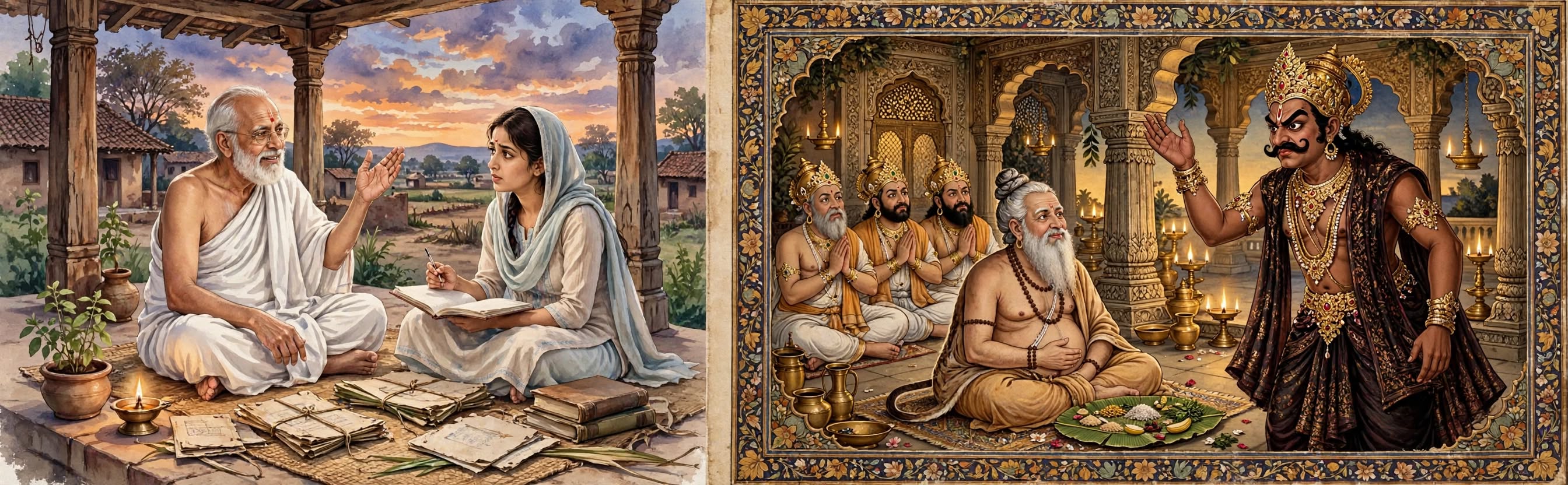
Question 6: Why didn't Vatapi come back out from the stomach? Acharya: In Manimati city, a demon named Ilvala and his younger brother Vatapi lived. The reason for Ilvala's enmity is also given in the 96th chapter of the Vanaparva. He had asked an ascetic brahmin, "Give me a son as valiant as Indra." The brahmin refused. That's it, ever since then he became an enemy of brahmins. Ilvala possessed a maya (magical illusion). Whoever he called by name would return even from Yamaloka (the realm of Yama, the god of death). In the Valmiki Ramayana, Aranyakanda, Sarga 11, when Rama goes to Agastya's ashram, this very story is narrated. It is added there that Ilvala used to assume the guise of a rishi and spoke pure Sanskrit. If any brahmin passed by, he would invite him with utmost respect for a Shraddha meal. Vatapi would turn into a ram. Ilvala would cook and serve him. As soon as the meal was over, Ilvala would shout: "Vatape, nishkramasva!" (Vatapi, come out!) And Vatapi would burst open the guest's stomach and come out laughing. Apala: Terrifying! And then Agastya went there? Acharya: Along with the three kings. Ilvala welcomed them greatly. The ram was cooked, the plate was served. The kings were trembling, they knew the secret. But Agastya said, "Do not worry. I alone will eat all of this." And he ate it up without leaving a single particle. Ilvala shouted, "Vatapi, come out!" Nothing happened. Shouted again. Silence. Then Agastya rubbed his stomach and said while laughing, "How can he come out, Ilvala? I have digested him." This dialogue is in the eighth and ninth verses of the 99th chapter of the Vanaparva. Apala: (Thinking a bit) Acharyaji, I don't understand this. Vatapi came out from everyone else's stomach, so why not from Agastya's? Just because "the rishi was great"? Acharya: No. This is the key to the whole story. Listen carefully. There are four levels in this story. First level: Body, Ayurveda. Look at the word "Vatapi". It contains "Vata". Vayu dosha among the three doshas of Ayurveda. If food is not digested properly, Vayu creates a storm in the stomach, as if it wants to burst the stomach and come out. Agastya means the blazing Jatharagni (digestive fire). The fire that digests even Vayu. That is why this verse is recited in folk tradition after eating: अगस्त्यं कुम्भकर्णं च शनिं च वडवानलम्। आहारपरिपाकार्थं स्मरेद् भीमं च पञ्चमम्॥ (Agastya, Kumbhakarna, Shani, Vadvanal meaning the fire in the ocean, and Bhima. These five are "maha-bhoji" (great eaters). Remembering them helps digest the food.) Agastya, Kumbhakarna, Shani, Vadvanal, meaning the fire in the ocean, and Bhima. These five are "maha-bhoji" (great eaters). If you remember them, the food gets digested. What your grandmother used to say was precisely this. Apala: So grandma was speaking Ayurveda, and didn't even know it! Acharya: This is the beauty of our tradition. Knowledge reached the kitchen in the form of a story. Second level: Mind, spirituality. Now your question. Why did Vatapi come out from others' stomachs? Because others only ate him, they did not digest him. Suppose you got angry, and you suppressed it. Did it go away? Apala: No. It stays inside. Acharya: Half-digested. Now if someone provokes you a little, Ilvala shouts, "Vatapi, come out!" And that anger, that desire, that old habit bursts the stomach and comes out again. Renunciation done superficially is just like this. True sadhana (spiritual practice) "digests" desire, melts it from the roots. Then no matter how much maya shouts, there remains no one inside to answer. And see, Ilvala's entire power was in "calling out". Where there is no listener left, that power becomes useless. Agastya's laughter is the fearlessness of a jnani (enlightened person). Apala: (Softly) "Vatapi jirno bhava" (May Vatapi be digested). It is not just for food... Acharya: ...It is for every dosha (fault). Third level: Society, dharma. Ilvala's sin was not just murder. He weaponized India's most sacred practice, hospitality. Killing the guest itself in a culture that proclaims "Atithi devo bhava" (The guest is equivalent to God). And that too in the guise of a rishi, speaking Sanskrit. Thus the story warns: dharma is not recognized by guise and language. And one small detail that many forget. What was the origin of the whole story? Apala: The unfulfilled boon. A son like Indra. Acharya: Yes. The vengeance of an unfulfilled desire. A mind that fills with poison upon hearing a "no" gradually becomes a demon. Fourth level: History. Hearing this will surprise you. There is a city called Badami in Karnataka. Its ancient name was "Vatapi". The capital of the Chalukya kings. Even today, there is a 7th-century "Agastya Tirtha" lake there. In 642 CE, the Pallava king Narasimhavarman conquered Vatapi. It is written in the Kuram copper plates of the Pallavas that he destroyed Vatapi just as the sage Agastya destroyed the demon Vatapi. And the king assumed the title, "Vatapikonda", the conqueror of Vatapi. Apala: So the king called himself Agastya! Acharya: The story was so well-known that it was used in political propaganda. And oral tradition says that an idol of Ganesha was brought from there to Tamil Nadu, "Vatapi Ganapati". Muthuswami Dikshitar composed the piece "Vatapi Ganapatim bhaje'ham" on it, which is sung even today in Carnatic music. Apala: But Acharyaji, is there any proof for the idol story? Acharya: (Happily) Bravo, this is the question I wanted. There is no written proof. It is an oral tradition. Copper plates and titles are historical, but the story of bringing the idol is a tradition. Preserving this distinction is true integrity. Apala: And what happened to Ilvala? Acharya: Here two texts say different things. According to the Mahabharata, a terrified Ilvala gave wealth. Ten thousand cows and gold to each king, double to Agastya, along with a golden chariot with mind-swift horses named Viravas and Suravas. According to the Ramayana, Ilvala, enraged by his brother's death, rushed at Agastya and was reduced to ashes by a single glance of the rishi. Apala: Two different endings? So which one is true? Acharya: Both are traditions. The same story was used in different texts to give a different message. The message in the Mahabharata is that the wealth of adharma (unrighteousness) comes to use in the work of dharma. The message in the Ramayana is that the end of adharma is certain. We preserve both, we do not impose one upon the other.
Question 7: A thousand sons or one? Acharya: Now the end of the story. Agastya brought wealth and fulfilled every desire of Lopamudra. Then he gave her a choice. In the twenty-first verse of the ninety-ninth chapter of the Vanaparva: ("What do you want? A thousand sons? Or a hundred, each equal to ten? Or ten, each equal to a hundred? Or just one, who conquers a thousand?") Apala: I think I know the answer. Acharya: Speak. Apala: Just one. She who maintained the limits of asceticism even while asking for ornaments, will not ask for quantity. Acharya: (With a smile) Correct. Lopamudra said, "One virtuous son is better than numerous wicked sons." Staying in the womb for seven years, a radiant child was born, who began reciting Vedic mantras the moment he was born. His name was Drdhasyu (Firm-hearted). He used to bring samidh, meaning idhma (sacrificial fuel), for his father's sacrifice. Therefore people called him Idhmavaha (Carrier of fuel). Apala: "Idhmavaha", the one who keeps the sacrificial fire burning. Meaning... Acharya: ...The carrier of tradition. The one who passes on the fire of knowledge to the next generation. And at that very moment, those hanging ancestors were liberated. Apala: (Writing something in her notebook) The story ended right where it began. Starting with ancestral debt, ending with Idhmavaha. In between, the balance of asceticism and householder life, righteous and unrighteous wealth, and the matter of digesting a flaw. Acharya: You stated the essence of the entire story in one breath. And do not forget the seven-year gestation period; great creation does not happen in a hurry.
The flame of the lamp had grown dim. Apala closed the manuscript, but did not stand up. Apala: Acharyaji, one matter remained incomplete today. You said that Lopamudra was a rishika (female seer), a mantra-drashta (seer of mantras), and the tradition of Srividya is in her name. But in today's entire narrative, she appeared only as a wife and a mother. Acharya: That is precisely why tomorrow is her day. Tomorrow we will open the 179th hymn of the Rigveda. There, Lopamudra speaks not through the mouth of a storyteller, but in her own words. And upon hearing the very first word, you will be startled. Apala: Which word? Acharya: (Standing up) "I am weary." Let us save more for tomorrow. Apala burst into laughter. As she was leaving, she stroked her stomach and softly said, "[[वातापि जीર્ણો ભવ]] (May Vatapi be digested)." This time those words were not of the kitchen, but of spiritual practice. ________________________________________ Read ahead → Part 2: "I am weary" — Rishika Lopamudra and Srividya ________________________________________ References for this part Subject Original Source Birth from a pot Rigveda 7.33.10–13; Matsya Purana; Brihaddevata Hymns of Agastya, Water prayer Rigveda 1.165–1.191 Hymn of Apala Rigveda 8.91 Etymology of the name Valmiki Ramayana, Ayodhya Kanda 2.11 Three debts Taittiriya Samhita 6.3.10.5; Shatapatha Brahmana 1.7.2.1–5 Pitris (ancestors), Creation of Lopamudra, Ilvala's vengeance Mahabharata, Vana Parva, Chapter 96 Marriage and Lopamudra's condition Vana Parva, Chapter 97; Marriage location Vana Parva 130.5 Shrutarva, Bradhnashva, Trasadasyu Vana Parva, Chapter 98 End of Vatapi, Ilvala's charity, Birth of a son Vana Parva, Chapter 99 (Verses 8–9, 21) Ilvala's disguise and the end in Ramayana Valmiki Ramayana, Aranya Kanda, Canto 11 Vatapi = Badami, "Vatapikonda" Pallava Kuram Copper Plates (7th Century) Verse of digestion Oral tradition Statue of Vatapi Ganapati Oral tradition (no written evidence) Note: The exact numbering of Taittiriya and Shatapatha for the three debts should be verified with the original texts prior to publication.
Leave a reflection
Your name and words appear below. Your email is kept private and never shown.