Agastya — Part 2 Lopamudra : Rishika and Srividya Guru
पूर्वीरहं शरदः शश्रमाणा दोषा वस्तोरुषसो जरयन्तीः। मिनाति श्रियं जरिमा तनूनामप्यू नु पत्नीर्वृषणो जगम्युः॥
rugved
"For many autumns, day and night, through dawns bringing old age, I labored in penance. Old age robs the body of its beauty. Now husbands should come to their wives."
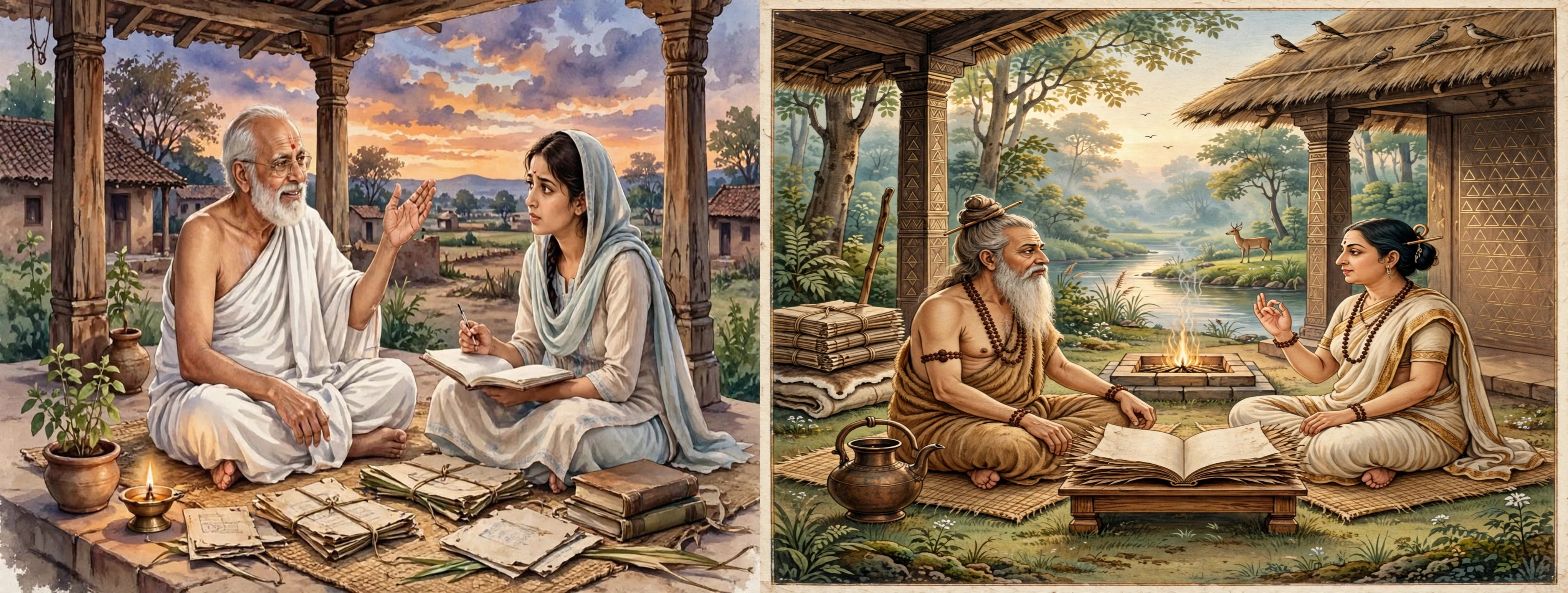
Beginning The morning of the next day. In the courtyard of the school, near the basil platform, Acharya Agastya was sitting with an old manuscript of the Rigveda open. When Apala arrived, he turned the manuscript toward her. Acharya: Come, Apala. Today we will not tell a story, but read the original mantra. First Mandala, Sukta 179. Six mantras. One of the human dialogues of the Rigveda. Apala: Acharya-ji, last night something kept bothering me. You said that the Rishika confesses her fatigue in the Veda. A Rishi praises the gods and chants the mantras of the Yajna. Why is the topic of fatigue in the Veda? Acharya: That is the specialty of this Sukta. Here there is no praise of Indra or Agni. An ascetic couple talks openly about a question of life: how to strike a balance between asceticism and householder life? And that conversation is initiated by a woman. According to the traditional Anukramani (index) of the Sukta, mantras 1 and 2 belong to Lopamudra, 3 and 4 to Agastya, and 5 and 6 to a disciple who overheard this dialogue. Apala: A disciple? Where did he come from there? Acharya: (Smiling) Have patience. That matter will come in the fifth mantra.
Question 1: Why was Lopamudra tired? Acharya: The first mantra. Listen carefully: पूर्वीरहं शरदः शश्रमाणा दोषा वस्तोरुषसो जरयन्तीः। मिनाति श्रियं जरिमा तनूनामप्यू नु पत्नीर्वृषणो जगम्युः॥ Its meaning is: "For many autumns, day and night, through dawns that bring old age, I have labored in asceticism. Old age robs the body of its beauty. Now husbands should come to their wives." Apala: Acharya-ji, this is a direct complaint! The Rishika tells her husband that my age is passing by, and you are immersed in asceticism. Acharya: Yes, direct and honest. But look at the words. "Purvih sharadah", many autumns. Years are counted by "Sharad" (autumn). And remember, yesterday I told you in which season Agastya's star rises? Apala: In Sharad! Acharya: Whether that is a coincidence or a sign, I do not say definitively. But for the Rishi's wife to measure time by counting autumns, and the Rishi himself to become the star of autumn, is a beautiful connection. (This is my observation, not the word of the commentators.) Now the deeper meaning. Lopamudra perceives time here. "Ushaso jarayantih", every dawn, every morning brings a little old age. Life is limited. And dry asceticism, which rejects life, does not fulfill life either. Apala: But is this not merely a bodily desire? Acharya: If it were only that, the second mantra would not exist. In the second mantra, Lopamudra argues.
Question 2: What was Lopamudra's argument? Acharya: ये चिद्धि पूर्व ऋतसाप आसन्त्साकं देवेभिरवदन्नृतानि। ते चिदवासुर्नह्यन्तमापुः समू नु पत्नीर्वृषभिर्जगम्युः॥ "The ancient seers who followed rta (cosmic order), who spoke truth with the gods, also stopped without reaching the end. Those ancestors too were joined with their wives." Apala: (placing her finger on the manuscript) So Lopamudra means that even great sages did not reach the "end" through asceticism, and they too did not abandon household life? Acharya: Exactly. Look at the structure of her argument. In the first mantra, personal experience: I am tired, time passes. In the second mantra, proof from tradition: ancestral sages also lived just like this. And the foundation is rta, the law of the universe. Sages who followed rta were also in worldly life, so the worldly life is not against rta. Apala: Acharya ji, this is just like an argument presented in a court of law! Experience, tradition, and principle. Acharya: And that too in a thousands-of-years-old text, from the mouth of a woman. This is what makes Lopamudra a "Rishika" (female seer). Not beauty, but a clear and logical voice.
Question 3: What did Agastya reply? Acharya: The third mantra, by Agastya: न मृषा श्रान्तं यदवन्ति देवा विश्वा इत्स्पृधो अभ्यश्नवाव। जयावेदत्र शतनीथमाजिं यत्सम्यञ्चा मिथुनावभ्यजाव॥ "The labor that the gods protect is not in vain. Together, we shall conquer all conflicts. If we become one, advancing as a pair, we shall win even this life-race of a hundred paths." Apala: I thought the sage would get angry, or defend his asceticism. Acharya: He does that too, in the first three words: "na mṛṣā śrāntam" (not in vain is the labor), my labor is not in vain. He does not call asceticism useless. But he immediately adds, "Both of us together". "Mithunau", as a couple. Asceticism and married life together alone can win the "śatanītha ājī", the competition of a hundred paths. Apala: So Agastya accepts his wife's argument, but does not abandon his own asceticism. Acharya: This is dialogue, Apala. Not argument. One speaks, the other listens, and from the truth of both, a third path emerges. As we saw in the Mahabharata yesterday, right? Lopamudra says, "Bring wealth in such a way that asceticism does not diminish." Here Agastya says, "Asceticism is not in vain, but we will win together." Two texts, the same message.
Question 4: What is in the fourth mantra? Apala: Acharya ji, you did not read the fourth mantra. Acharya: The fourth mantra is a poetic description of the rise of kama, that is, desire. In it, there is the acknowledgment that even a steadfast ascetic is not detached from desire. Its language is conjugal, so in the courtyard of the school, its sentiment alone is sufficient. Tradition attributes it to Agastya, though some scholars place it in the mouth of Lopamudra. Apala: That the Veda contains such matters as well, that itself is the surprising thing. Acharya: The Veda does not run away from life, Apala. It places every aspect of life, even desire, within the framework of rta. Not to hide it, but to keep it within bounds. And that is what the fifth mantra is about.
Question 5: Why did the disciple ask for forgiveness? Acharya: Now about that disciple. In Shaunaka's Brihaddevata, the background of this hymn is given in verses 57 to 59 of the fourth chapter. A disciple of Agastya overheard this dialogue unintentionally. Then, through the power of his penance, he understood what had happened, and felt that he had committed a sin by listening to the private conversation of the guru couple. Therefore, he chanted this mantra: इमं नु सोममन्तितो हृत्सु पीतमुप ब्रुवे। यत्सीमागश्चकृमा तत्सु मृळतु पुलुकामो हि मर्त्यः॥ "I closely pray to this Soma drunk within the heart: forgive whatever fault has been committed by us. Because man is filled with many desires." Apala: (Softly) "Pulukamo hi martyah." Man is full of many desires. Acharya: A thoroughly honest statement of the Vedas. No hypocrisy. He does not say "We are complete," he says "We are filled with desires, forgive us." Apala: But Acharya ji, what was the disciple's fault? He had not listened knowingly. Acharya: Excellent question. Look at the deeper meaning. Receiving knowledge comes with responsibility. Not every matter is to be heard at all times. The disciple realized that limitation, and accepted his fault. This very humility makes him a seer of the mantra. His plea for forgiveness was also preserved in the Vedas. And understand the reason why we remember this matter today as well: we will observe this same restraint in the matter of Srividya too. In a little while.
Question 6: What is the meaning of "both varnas"? Acharya: The last mantra. You will encounter this mantra again in the third part, at dawn, while offering arghya to the Agastya star. अगस्त्यः खनमानः खनित्रैः प्रजामपत्यं बलमिच्छमानः। उभौ वर्णावृषिरुग्रः पुपोष सत्या देवेष्वाशिषो जगाम॥ "Digging with hoes, Agastya desired progeny, offspring, and strength. That fierce sage nourished both varnas, and obtained true blessings from the gods." Apala: "Ubhou varnou" (both varnas), both varnas. Which two varnas? Acharya: Scholars debate this question a lot. Some understand it as two social classes. But in the context of this sukta, the most prevalent and consistent meaning is: the two paths of life, asceticism and householder. The word "varna" in its root meaning is color or type. Agastya did not abandon either of the two. He nourished both. Apala: And "digging with hoes"? Does the sage do farming? Acharya: Taken literally, yes. The sage is also a laborer, connected to the earth. Looked at in a esoteric sense, digging means going deep, reaching the root. Asceticism is also digging, and so is householder life. And one who goes deep into both, receives "satya ashishah" (true blessings). Apala: The sukta begins with Lopamudra's fatigue, and ends with Agastya's nourishment of both paths. In between is argument, acceptance, desire, and forgiveness. Acharya: And hear the vision of a scholar as well. The French Vedic scholar Abel Bergaigne saw a mystical meaning in this sukta. According to him, Agastya is the divine Soma, and Lopamudra is the intense prayer, which after a long effort brings Soma down from its secret dwelling. Apala: So the entire sukta is a metaphor for worship? Acharya: According to one perspective, yes. Prayer gets tired, argues, and finally the divine nectar descends. If you remember, Yaska's three levels. Literally, a dialogue of this couple. On the spiritual level, the union of prayer and Soma. Both are true.
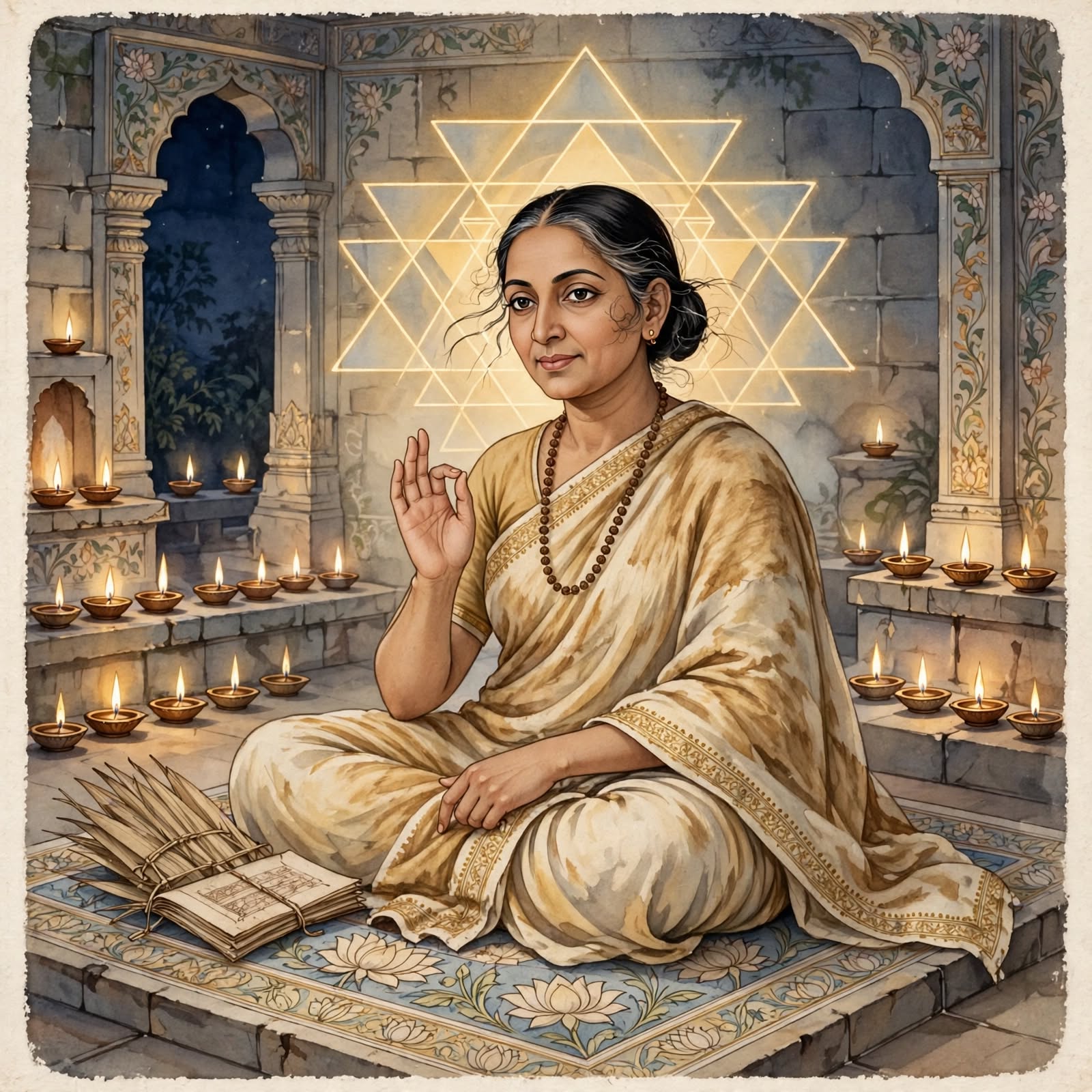
Question 7: The connection between Apala and Lopamudra? Apala: Acharya ji, a personal question. Yesterday you said my name is derived from the Rishi Apala. What is her story? Any connection with Lopamudra? Acharya: (Turning the pages of the manuscript) Rigveda, eighth mandala, sukta 91. Apala was the daughter of Rishi Atri. According to traditional lore, her husband abandoned her due to a skin disease. She lived at her father's house, and one day while going to the river, she found the soma plant. She crushed the soma with her teeth and offered it to Indra, and Indra cured her of her disease. Apala: Both stories feature soma! Acharya: And in both, the woman takes the initiative herself. Lopamudra questions her husband. Apala, without losing hope even after being abandoned, finds her own path. Neither waits around. Both compose mantras. There are many female seers (rishikas) in the Vedas—like Lopamudra, Apala, Ghosha, Vishvavara, Gargi—and the commonality among all of them is this: their own voice. Apala: (Remaining silent for a moment) Now I understand the meaning of my name. ________________________________________ Question 8: What is Lopamudra's place in Srividya? Acharya: Now for another aspect. In the Vedas, Lopamudra is a rishika (female seer). But in Tantra, she is a guru, and the founder of an entire tradition. Acharya ji, the very mention of Tantra frightens people. Acharya: Because the word has been misused. Srividya is the worship of Devi Lalita Tripurasundari, one of the most subtle and classical methods of worship in India. Srichakra is worshipped even in the monasteries of Adi Shankaracharya's tradition. Its root mantra is Panchadashi, consisting of fifteen syllables. And there are two main sects of this mantra. Kadi Vidya Hadi Vidya First syllable of the mantra "Ka" "Ha" Founder Kamadeva Lopamudra Guru-parampara (Lineage of Gurus) Parama Shiva → Durvasa → Hayagriva → Agastya Lopamudra Foundational texts Tantraraja Tantra, Vamakeshvara Tantra Tripuropanishad Prevalent region All of India Especially Kerala
Apala: (With surprise) Meaning Agastya is the preceptor of one tradition, and Lopamudra of another! Husband and wife, both independent gurus! acharya: Yes. And worshippers of the Hadi tradition believe that in the Kali Yuga, the principal guru of this vidya (knowledge) is Lopamudra, and all worshippers of this age are her children. Therefore, they worship Lopamudra as "Mother". In that tradition, there is also a mantra in the name of "Shri Lopamudramba". Apala: Acharyaji, what is that mantra? The fifteen syllables of Hadi Vidya? acharya: (Closing the manuscript gently) Remember the words of that disciple over here, Apala. Every matter is not to be heard at all times. Gurus impart the mantras of Srividya only through initiation. (Writing it in a book or on a website is disrespectful to that tradition.) I will tell you its place, history, and meaning, but not the syllables. Apala: (Humbly) Understood, Acharyaji. Then what does the distinction between "Ka" and "Ha" indicate? acharya: That I can tell as an interpretation. In the Sanskrit alphabet, "Ka" is the first consonant, and "Ha" is the final. One starts from the beginning of creation, the other from dissolution or absorption. Agastya and Lopamudra together embody the beginning and end of the alphabet, thus holding the complete Shabdabrahma. The statement "Mithunou" (couple) in the hymn of the Rigveda, that both shall conquer together, is fulfilled here at the level of the alphabet. (This is my interpretation. The secret meanings of Tantra are obtained only from the initiated guru.)
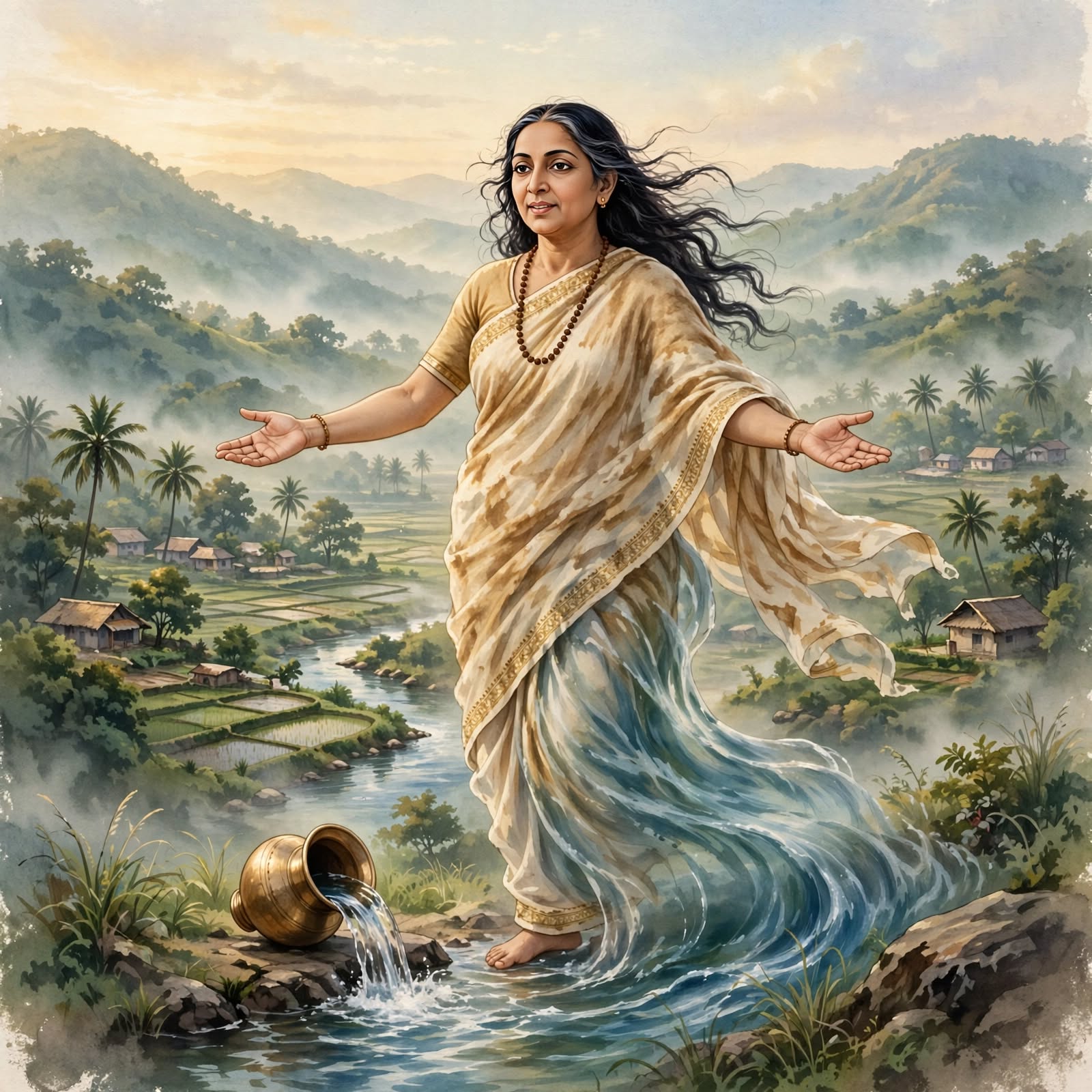
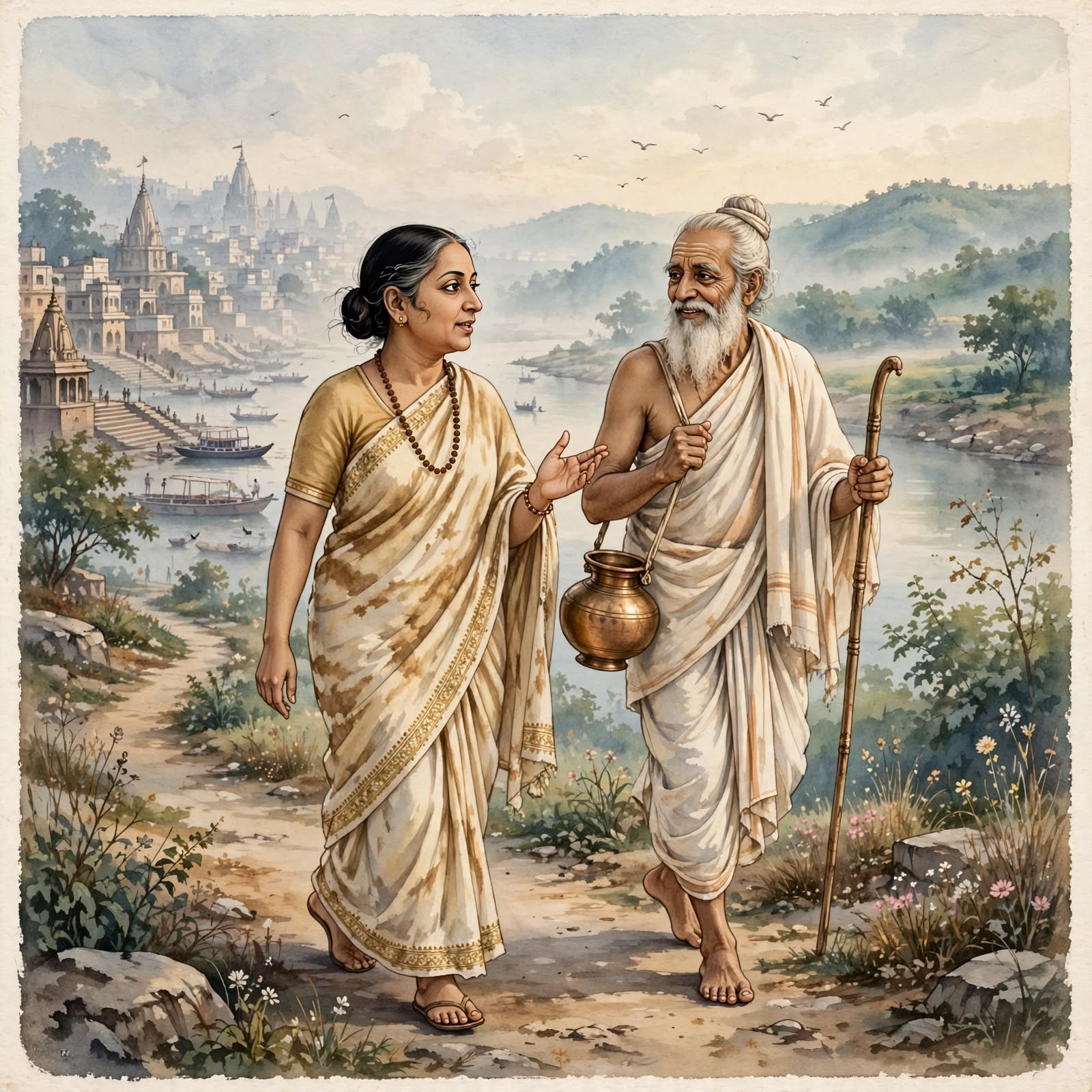
Question 9: What do the Puranas say about Lopamudra? Acharya: Let us look at three texts. First, the Lalitopakhyana of the Brahmanda Purana. This entire text is a dialogue between Hayagriva and Agastya, a dialogue just like the one we are having right now, as mentioned earlier. It contains the famous Lalita Sahasranama. According to the narrative, distressed by the sorrows of Kali Yuga, Agastya performed austerities in Kanchi. At that time, Goddess Lalita told Hayagriva that both Agastya and Lopamudra are extremely dear to Her. Thereafter, Agastya received the secret Lalita Trishati. In the 38th chapter of the same text, a series of mantras is given, and the Lopamudra mantra and Kamaraja mantra have been declared as the best of all. Apala: The Goddess takes the names of both together. Acharya: Yes, the Goddess recognizes Lopamudra not as the "wife of Agastya", but as a devotee dear to Herself. Second, the Kashi Khanda of the Skanda Purana. In the first six chapters, Agastya leaves Kashi and goes to the South, which is that journey. Lopamudra is with him. Along the way, Agastya explains the glory of the tirthas (sacred pilgrimage sites) to Lopamudra. They visit Goddess Mahalakshmi of Kolhapur. Here, Lopamudra is an ideal example of pativrata dharma (the duty/path of a devoted wife). Apala: Acharyaji, many questions are raised today on the word "pativrata". Acharya: Questions should be raised. But look at the portrayal in the Kashi Khanda. Lopamudra is not a silent follower. The entire journey is a dialogue, where the husband explains and the wife asks. In the same way, just as we are sitting right now. The meaning of pativrata is to walk alongside, not to walk behind. Third, the Kaveri Mahatmya. The tradition of South India, especially of Kodagu, says that Lopamudra herself became the River Kaveri. Agastya used to keep her in his kamandalu (water pot) in the form of water. One day, Ganesha took the form of a crow and tipped over the kamandalu, and the river flowed out from Talakaveri. (There are several different versions of this story.) Apala: (Laughing) Ganesha tipped over the sage's kamandalu! Acharya: And look at the deeper meaning. If knowledge remains confined within a kamandalu, it remains limited to one person. When it is spilled, it nourishes an entire region. Lopamudra's knowledge did not stay confined in the sage's kamandalu; it flowed as a river. And Ganesha, the remover of obstacles, is the one who tipped it over. And what did I say yesterday? Every story of the sage born from a kumbha (pot) is about water. Here, his wife herself becomes water.

Conclusion The sun had come right overhead. Acharyaji tied up his manuscript bundle. Apala: Acharyaji, yesterday Lopamudra seemed like a character to me. Today she appeared in four different forms: a rishika (female sage) debating in the Rigveda, a mother-like guru in Sri Vidya, a co-traveler conversing in the Kashi Khanda, and flowing water in the Kaveri. Acharya: And the single thread running through all four, Apala, is voice. Lopamudra is nowhere silent. Apala: What next now? Acharya: Now we will leave the earth and go to the sky. Tomorrow morning before sunrise, at around half-past five, keep your eyes fixed on the south-eastern horizon. Apala: What will be seen? Acharya: (With a smile) A sage who drank the ocean. And with the very same mantra that we read last at the end today, we will offer arghya (libation) to him.
Read further → Part 3: The Morning Star — The Drinking of the Ocean, Vindhya, and the Agastya Constellation
References for this part Topic Original Source Lopamudra-Agastya dialogue, six mantras Rigveda 1.179 Story of the disciple Brihaddevata (Shaunaka) 4.57–59 Interpretation of the Soma-prayer Abel Bergaigne, La Religion védique Female seer Apala Rigveda 8.91 (Apala's story from traditional commentaries and Brihaddevata) Kadi Vidya Tantraraja Tantra; Vamakeshwara Tantra Hadi Vidya Tripuropanishad; Srividya upasaka tradition Lalita Sahasranama, Trishati, Lopamudra mantra Brahmanda Purana, Lalitopakhyana (Chapters 38–39) Journey from Kashi to the South Skanda Purana, Kashikhanda, Purvardha Chapters 1–6 Lopamudra = Kaveri Skanda Purana, Kaveri Mahatmya; Kodagu tradition
Leave a reflection
Your name and words appear below. Your email is kept private and never shown.