Agastya — Part 3 Morning Star: Samudrapana, Vindhya and Agastya Nakshatra
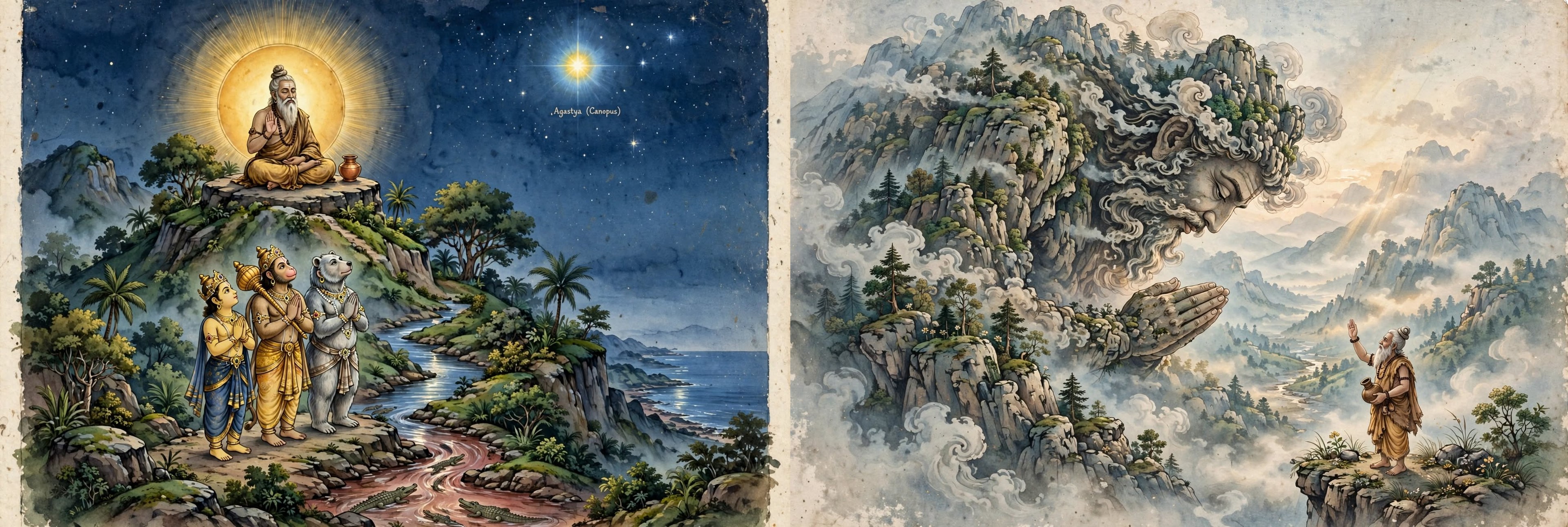
उदित अगस्ति पंथ जल सोषा। जिमि लोभहि सोषइ संतोषा॥
તુલસીદાસ, રામચરિતમાનસના કિષ્કિંધાકાંડમાં, શરદ-વર્ણન
Agastya rose, and the water on the path dried up, just as contentment dries up greed.
Beginning On the third day, the darkness before sunrise. The cold autumn breeze was blowing on the small hill situated to the south of the pathshala (school). Acharya Agastya was standing facing the south direction, taking water in a copper pot, a few flowers, and akshat (unbroken rice grains). Apala came wrapped in a shawl. Apala: Greetings, Acharya-ji. (Looking towards the sky) That brilliant star, is that Agastya? Acharya: No, child. That is Vyadha, Sirius in English. The brightest star in the entire sky. Now bring your gaze down from there, all the way towards the southern horizon. Near the top of the trees, in a faint mist, a star is flickering slightly, sometimes yellow and sometimes blue. Apala: (After searching for a little while) Yes! I saw it. But it is very low. Acharya: That is Agastya, Canopus. The second brightest star of the night sky. From our latitude, it never rises high, it stays near the southern horizon itself. Further north, above approximately 37 degrees latitude, it is not visible at all. Since the light passes through the air near the horizon, it flickers and appears to change colors. Apala: The sage went to the south, and the star also in the southern sky! Acharya: That is not a coincidence, Apala. Today we will see just that: the story on earth and the event in the sky are one and the same. But first, duty. Do you remember the mantra we read last at the end yesterday? Apala: "Agastyaḥ khanamānaḥ khanitraiḥ..." The sixth mantra of Rigveda 1.179. Acharya: Today we will offer arghya (water offering) with that very mantra. Acharya-ji raised the pot and slowly offered water to the ground in the southern direction: अगस्त्यः खनमानः खनित्रैः प्रजामपत्यं बलमिच्छमानः। उभौ वर्णावृषिरुग्रः पुपोष सत्या देवेष्वाशिषो जगाम॥
Question 1: An offering to a star? Where is that written? Apala: Acharya-ji, we've seen making water offerings () to the sun. But to a star? Where did this ritual come from? Acharya: From Varahamihira's Brihat Samhita, sixth century. Its entire twelfth chapter is solely about Agastya, "Agastya-chara" (The Movement of Agastya). There, the prescription is that when a redness appears in the eastern direction at dawn, an offering (arghya) on the earth should be given to Agastya rising in the southeast. And Varahamihira also notes a scientific fact: the time of rising differs at different places, which an astrologer must calculate and determine. Apala: So he knew that a star appears at different times depending on the latitude? Acharya: Exactly. And a warning is also written: if this star is struck by a comet or a meteor, a famine occurs. Apala: This sounds like blind faith. Acharya: (Smiling) Perhaps if taken literally. But look, Varahamihira connects Agastya with water and rain. The star appearing dim means there is dust or fog in the sky, implying the rainy season has been disrupted. This saying is based on observation. And the most important thing: that very chapter begins with the tale of the drinking of the ocean. Apala: A Puranic story in an astrological text? Acharya: Yes. The first five verses of the twelfth chapter describe the ocean without water after being drunk. The jewels there were so sparkling that even the crowns of the gods appeared dim. And the verses immediately following describe the Sharad (autumn) season, which begins with the rising of Agastya. Thus, the astrologer himself connects the story and the star. We are not discovering anything new; we are simply reading what they said.
Question 2: What is the story of the drinking of the ocean? Acharya: First the story, then the meaning. In the Vana Parva of the Mahabharata, chapters 101 to 105. The Kalakeya demons, followers of Vritrasura, used to hide in the ocean during the day and come out at night to slaughter the rishis in their hermitages. The gods were troubled because the enemy was completely invisible. Vishnu said, "The demons can only be caught if the ocean dries up. And only Agastya can do this work." (The gods approached Agastya.) The rishi came to the ocean shore, took the entire ocean in his palm, and drank it up in full view of everyone. The bed of the ocean was exposed, the Kalakeyas were seen, and the gods destroyed them. Apala: And the ocean? Did it remain empty? Acharya: The gods asked Agastya to return the water. The rishi said, "It has been digested." (Apala laughed.) Yes, just like Vatapi. Then Vishnu said that when Bhagiratha brings Ganga down to earth through his penance, the ocean will fill up again. This story leads directly into the tale of Bhagiratha and Ganga. Apala: Acharya-ji, I am most skeptical about this. In the story of Vatapi, you showed four layers, and all of them made sense. But drinking the ocean? What could this possibly mean? Acharya: Then let us look at five layers today. And the first layer is right before your eyes. On the horizon.
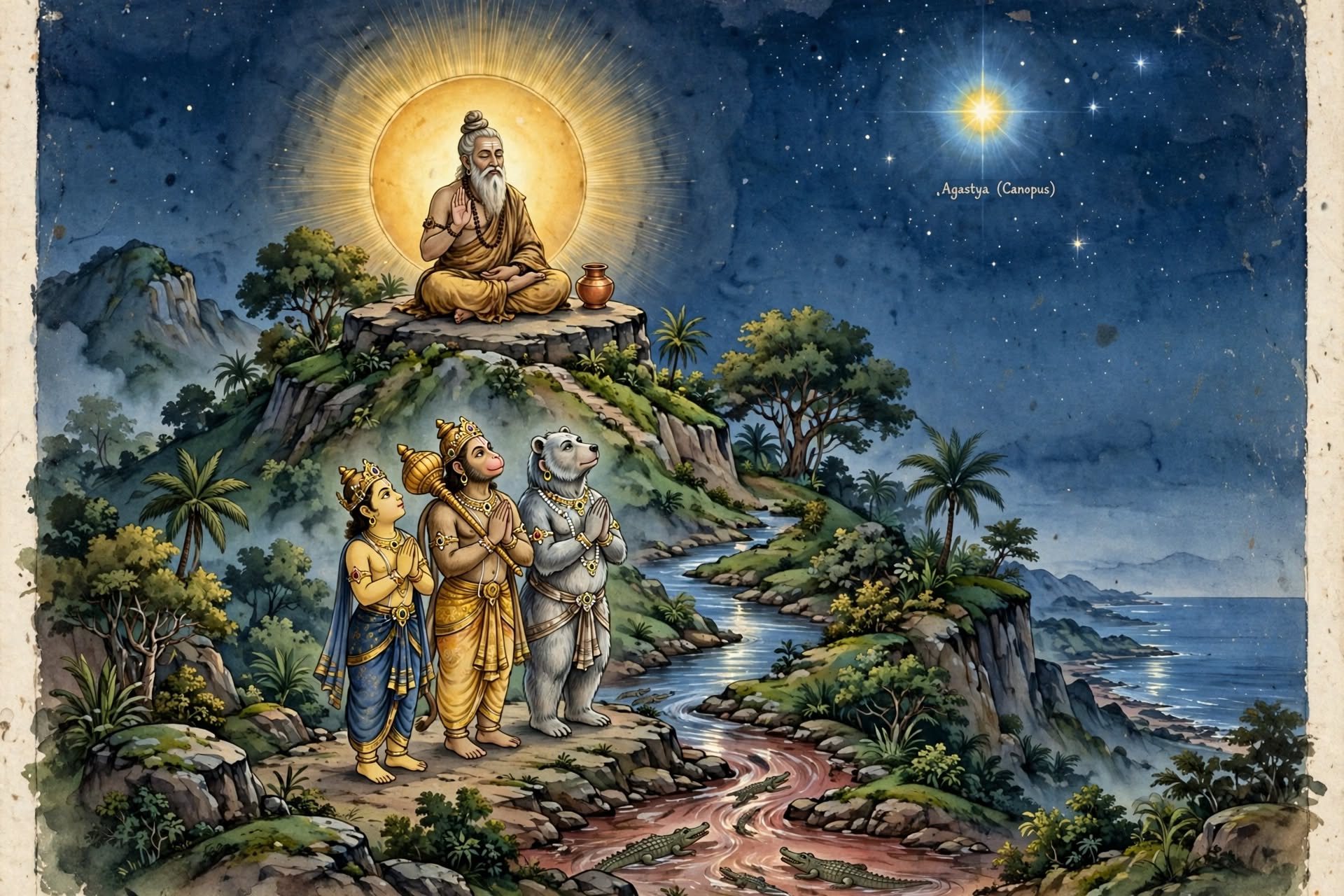
Question 3: The first layer, the ocean of the sky Teacher: Apala, which season is it today? Apala: Sharad (autumn). The monsoon just ended. Teacher: And when does this star appear for the first time in the year at dawn? In the language of astronomy, this is called a heliacal rising. According to the calculations of astronomer K. D. Abhyankar, at the latitude of North India, at approximately 26 degrees, this rising always occurs after the middle of August. Therefore, for thousands of years, the rising of Agastya has meant the end of the monsoon. Now imagine. For four months the sky is covered with clouds, rivers are muddy, water is in the fields, roads are in the mud. Then one morning this star appears on the southern horizon, and in a few days the sky is clear, clouds disappear, water is pure. Apala: (Softly) As if someone drank the ocean of the sky... Teacher: Exactly. The "celestial ocean" of clouds and rain is drunk by Agastya. And this is not my imagination. Our great poets themselves have written this. Kalidasa, in the fourth canto of Raghuvamsa, at the beginning of Raghu's conquest of the quarters, describes Sharad: प्रससादोदयादम्भः कुम्भयोनेर्महौजसः। (Raghuvamsa 4.21) With the rising of the supremely radiant Kumbhayoni (born from a pot, i.e., Agastya), the water became prasanna, meaning pure. And Tulsidas, in the Kishkindha Kanda of Ramcharitmanas, in the description of Sharad: उदित अगस्ति पंथ जल सोषा। जिमि लोभहि सोषइ संतोषा॥ Agastya rose, and the water of the paths dried up, just as contentment dries up greed. Apala: Tulsidas gave two meanings in a single chopai (quatrain)! Teacher: That is the fifth layer. That will come later. Apala: But Acharyaji, one thing. Does this star rise at the same time all over India? Teacher: (Delighted) No. And Abhyankar himself notes this. In South India, at 14 degrees latitude, this rising occurs before mid-August, when it is still raining there. Therefore, this seasonal indicator appears to have originated from the observation of North India. Honestly speaking, this limitation also has to be accepted.
Question 3: What is Hamsodaka? Teacher: Now Ayurveda. Look, what happens after the star rises? The water becomes pure. Ayurveda gives a special name to this water: Hamsodaka (water fit for swans). Vagbhata, in the third chapter of Sutrasthana of Ashtanga Hridaya, in Ritucharya says: Water warmed by the sun's rays during the day, cooled by the moon's rays at night, and rendered nir-visha (toxin-free) by the rising of Agastya is called Hamsodaka. It is pure and removes doshas (humors). This same concept is also in Sushruta Samhita. Apala: "Nir-visha"? Poison in the water? Teacher: Monsoon water. Mud, decay, germs. Today we call these "waterborne diseases." Ayurveda says that after Agastya rises, the water becomes fit to drinking. In modern times, a study was even conducted for two years analyzing the chemical and microbiological water of reservoirs to test this claim. Apala: So the story is a health calendar! "Drink water after Agastya rises." Teacher: Exactly. What is forgotten as a rule is remembered for generations as a story. This was the method of our ancestors.
Question 5: The second layer, who were the Kalakeyas? Apala: So the Kalakeya Daityas? Are they also some symbol? Acharya: Look at the word "Kalakeya". Kala means dark, or darkness. And their behavior: they hide in the water by day, and come out at night to sting. Now let us open the Rigveda. The 191st hymn of the first mandala, which is considered to be by Agastya himself, and is the last among his hymns. Apala: What is it about? Acharya: About poison. Poisonous creatures living in the water, those hiding in the grass, scorpions, snakes, and insects that bite at night. The Rishi complains that these invisible creatures sting. And then he says that the sun will rise, and it will absorb that poison. At the end of the hymn, there is a beautiful imagery: the maidens of the Krittika nakshatra will carry that poison away, just as they carry water in a pot. Apala: (With enthusiasm) Acharyaji! Hiding in water, stinging at night, and destroyed by the sun or light. These are indeed the Kalakeyas! Acharya: You caught the connection yourself. The "Kalakeyas" who hide in water during the monsoon and attack at night are the venomous insects of the rainy season, water-borne diseases, and the fears of the night. Agastya rises, the waters recede, the "ocean dries up", and the hidden enemies are exposed and destroyed. What was the concern of the Rigvedic Rishi became a story in the Puranas. But remember, this connection is an interpretation. The subject matter of hymn 1.191 is clear in the text, but no text explicitly says "Kalakeyas mean insects". We are looking at both by putting them together.
Question 6: The third and fourth layers, seafaring and the water cycle Acharya: The third layer. What is the ocean like during the monsoon? Apala: Stormy. Even fishermen do not go out to sea. Acharya: And when the monsoon ends, Agastya rises, then the ocean becomes calm, and ships can set sail. Abhyankar suggests that "drinking the ocean and filling it again" may also be a symbol of crossing the ocean. And listen, Agastya is immensely revered in Indonesia across the Indian Ocean. In Java, there is an 11th-century text named "Agastya-Parva", which is a mixture of Sanskrit and the Javanese language. There, in medieval Shiva temples, the statue of Agastya is common, often in the form of a pot-bellied, bearded guru. Apala: Big belly, the one who digested Vatapi! Acharya: (Laughing) Perhaps. And Canopus itself is a star of navigation. Sailors used to look at it in the southern sky to find directions. In Western tradition too, it was considered part of the helm of the ship named "Argo". Both East and West have associated this star with the sea. Fourth layer, look at the end of the story. The ocean dried up. Then Bhagiratha performs penance, Ganga descends from heaven, flows from the Himalayas, and the ocean is filled again. Apala: This is the water cycle! The water of the ocean turns into vapor, becomes clouds, rains on the Himalayas, becomes a river, and goes back to the ocean. Acharya: And the message of the story: the emptying of the ocean is not the end. Whatever was taken away comes back through the rivers. Nature's cycle never stops.
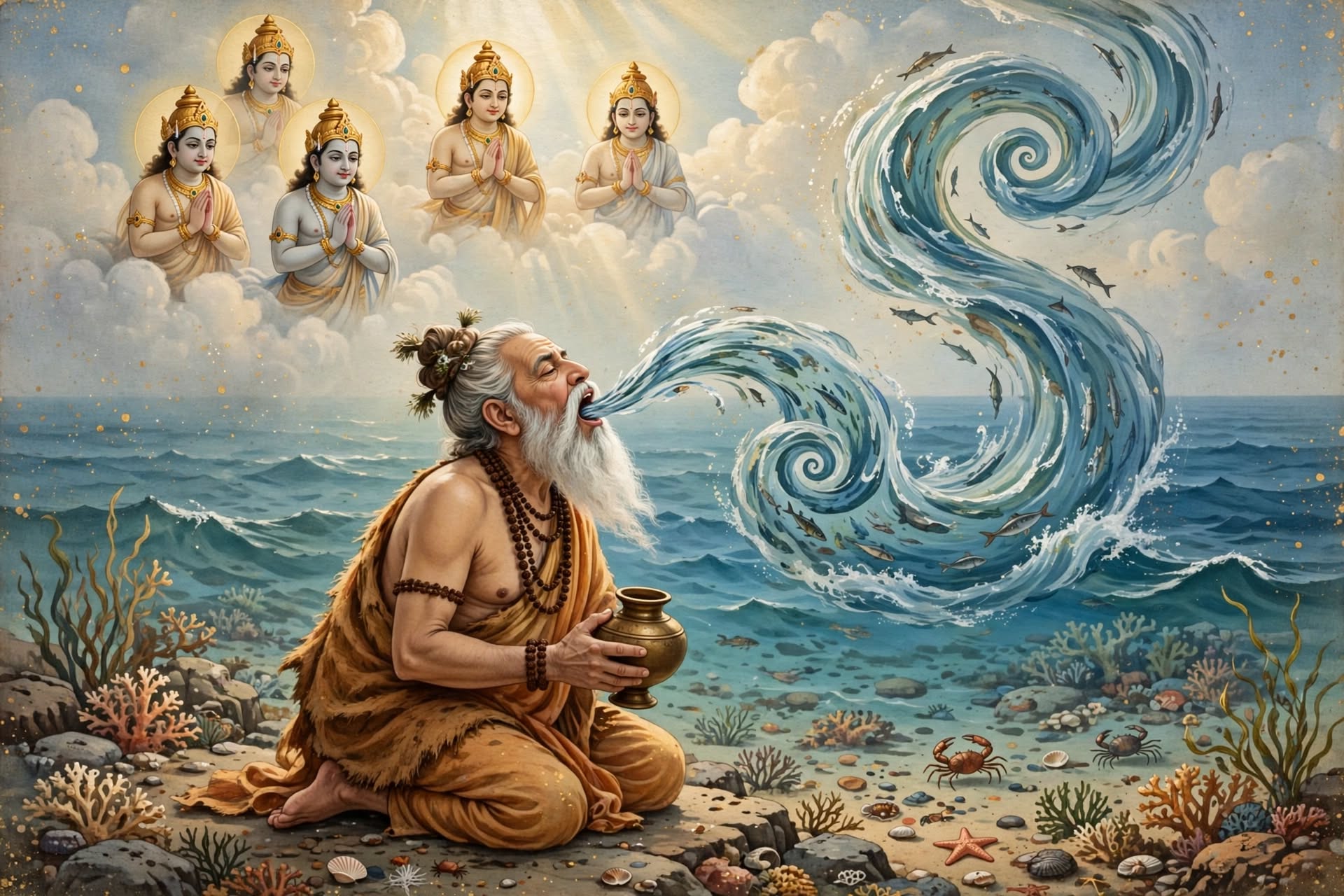
Question 7: The Fifth Level, The Ocean of the Mind Acharya: Now the second half of Tulsidas's couplet. "Just as contentment dries up greed (Jimī lobhahi sōṣai santōṣā)." Agastya means contentment. The ocean means craving. The ocean of craving is boundless, its bottom is not visible. And hidden within it are anger, greed, infatuation—our "Kalakeyas". By day, meaning when we are conscious, they are not visible. At night, meaning in a moment of weakness, they emerge and sting. Apala: And as long as the ocean is full, they cannot be caught. Acharya: Exactly. If we fight just one flaw at a time, it hides deep down again. Only when contentment drinks up the entire ocean, does the bottom become visible, and the flaws are exposed and destroyed. Apala: And then Ganga? Acharya: Then the Ganga of grace fills life anew. But this time not with salty water, but with pure water. Being emptied is not voidness; it is the preparation for a new filling. Apala: So the five levels of the ocean-drinking: the end of the monsoon in the sky, the poison-worry of the Rigveda, the ocean voyage, the water cycle, and contentment-craving. In the tale of Vatapi there were four, here five! Acharya: And pay attention, in both tales Agastya "digests" something. There a demon, here the ocean. Agastya means the power to digest. In the body the digestive fire (jatharagni), in nature the autumn star, in the mind contentment.
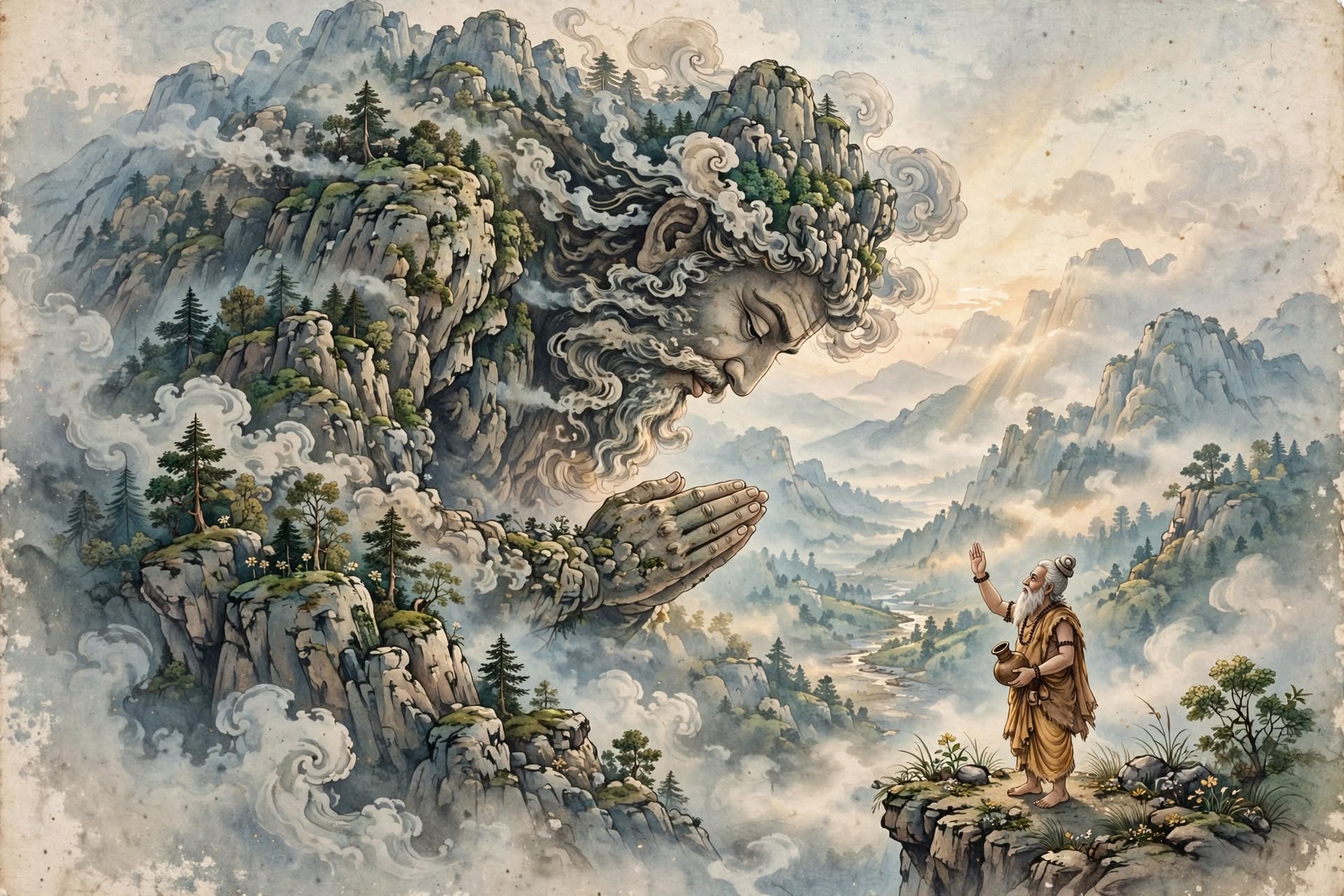
Question 8: Why Did Vindhya Bow? (In the east, the sky was now beginning to turn a pale pink.) Acharya: Now the second tale. In the 104th chapter of Vanaparva, and in detail in the Kashi Khanda of the Skanda Purana, in the first five chapters. According to Kashi Khanda, Narada Muni went to the Vindhya mountain and praised Mount Meru: "The sun circumambulates Meru." Jealousy arose in Vindhya's mind. It said to the sun, "Circumambulate me too." When the sun refused, Vindhya began to grow taller and taller, and blocked the sun's path. The gods went to Brahma, and Brahma sent Agastya. Agastya did not want to leave Kashi, but he went. As we saw yesterday, along with Lopamudra. Seeing his guru, Vindhya bowed his head to pay respects. Agastya said, "Remain bowed just like this until I return." And he never returned. Apala: (Laughing) The sage tricked the mountain! Acharya: Call it the guru's cleverness. Now the meaning. Geography: Vindhya is the natural wall between North and South India. "Vindhya bowed" means the sage crossed that wall, and a bridge of culture was built between North and South. G. V. Tagare, the English translator of the Skanda Purana, also notes that Agastya appears to be the first explorer to go south of the Vindhyas. Mind: Vindhya means ego. And pay attention, what did it grow from? From comparison. With Meru. Ego always grows from comparison with others. It bows before the guru. And the guru "does not return", meaning that humility becomes permanent. Sky: And now look at this star, Apala. The sage went from North to South and did not return. The star is also not visible in the North, it remains only in the South. And based on this very fact, researchers have set out to find the chronology of our history.
Question 9: How does this star determine the timeline of the Ramayana? Apala: Acharya-ji, please explain this to me. How is time determined based on a star? Acharya: The Earth rotates like a top, and its axis also completes a circle very slowly, in about 26,000 years. This is called axial precession, or precession in English. This means that over thousands of years, the positions of the stars in the sky change. The latitude from which Agastya is visible today was different in different eras. Now the logic: If the legend says that Agastya crossed the Vindhya mountains and went south for the first time, and if that legend is a memory of a star, then find a time when this star was visible from south of the Vindhyas, but not from the north. Apala: And where is Agastya in the Ramayana? Acharya: In the south from the very beginning. In the Aranya Kanda, Rama visits his hermitage in Dandakaranya. Therefore, the Ramayana is an event that occurred after the crossing of the Vindhyas. Now listen to the conclusions of the scholars, and keep your doubts ready. K. D. Abhyankar, in the Indian Journal of History of Science: According to his calculations, around 5000 BCE this star was visible from south of the Vindhyas, but not from the north. Thus, the time of Agastya is between 5000 BCE and 4000 BCE. "Vega and Canopus" Research Paper: Based on the Amarakosha and Surya Siddhanta, it argues that around 12,000 BCE, Abhijit (meaning Vega) was near the North Pole and Agastya was near the South Pole. And the crossing of the Vindhyas took place in or before 20,000 BCE. Nilesh Oak, in The Historic Rama: 12,209 BCE, based on the astronomical descriptions in the Ramayana. Rupa Bhatti, School of Indic Studies, USA: Her entire research is on Agastya. In her paper titled "The Etymology of Agastya is Astronomical in Nature", presented at the Sanskrit Conference at Maitreyi College, Delhi University in 2022, she states that astronomical events of the star are hidden within the very etymology of the word "Agastya". And based on the newly published Parashara Tantra and Amarakosha, she pushes the Vindhya legend back to 19,000 BCE. An interesting suggestion of hers is that "Agastya" was not a single individual, but a group of people who followed the star as it drifted southwards due to precession. Apala: (Stunned) Acharya-ji, 5000 BCE to 20,000 BCE? A difference of fifteen thousand years? This is... which of these is correct? Acharya: (Gravely) I was waiting for this very question. Now listen to the opposing view. Dr. Raja Ram Mohan Roy has tried to refute Nilesh Oak's calculations in detail across ten parts, but he only criticizes and does not provide any independent theory. His intention is merely to refute, not to find the truth, so we should not take it into account. According to his calculations, around 12,000 BCE Agastya was about 12 degrees away from the South Pole, so it cannot be called the "Polar Star". R. N. Iyengar suggests a much closer time, 1350–1130 BCE, based on Parashara's seasonal calculations. K. C. Hari notes, based on observations of Canopus made by the Greek astronomer Hipparchus from Rhodes, that in 4000 BCE this star was visible for a few days even from 30 degrees north. Apala: Then what should we believe? Acharya: Three things, Apala. First: All these are proposals, not universally accepted conclusions. Doubt anyone who calls any single date a "proven truth". Doubt me too. Second: Calculations rest on many assumptions. "The Vindhya legend is a memory of a star" is also an assumption. Change the assumption, and the result changes. Third, and most importantly: One thing is indisputable. Our texts have preserved observations of the sky so precisely that today, thousands of years later, they can be calculated using modern astronomical software. Whatever the date may be, the vision of the sky held by our ancestors is unquestionable.
Question 10: Nahusha in the sky too? Apala: Acharyaji, is there any other Agastya-legend connected with the sky? Acharya: Nahusha. In the Udyoga Parva of the Mahabharata. When Indra went into hiding due to the sin of killing a brahmin, Nahusha, the king of the earth, was given the position of Indra. Intoxicated by power, he made the Saptarishis (Seven Sages) carry his palanquin. Agastya Rishi was short, so the palanquin tilted. In anger, Nahusha kicked him, saying "Sarpa, Sarpa" which means "Walk fast". And by the curse of the rishi, Nahusha fell from the sky, having turned into a serpent. (There is a different version in the 100th chapter of the Anushasana Parva, in which Bhrigu, hidden in Agastya's matted locks, gives the curse.) Apala: Saptarishi, falling from the sky, a serpent... Are these stars too? Acharya: Some astronomy-historians conjecture that this is the memory of an ancient comet. From the Saptarishi, that is from the northern sky, a comet went towards the south, up to the star Agastya. Its tail kept growing longer, like a serpent, and then it disappeared below the horizon. People saw that the celestial "king" descended from the Saptarishi, "touched" Agastya, and fell. Apala: That means the kick = the touch of the comet's tail! Acharya: According to one interpretation, yes. And the moral meaning is clear: if the intoxication of power kicks the wise, downfall is certain. Whether it is the sky or a kingdom, the rule is the same. (During this time, the first redness of the sun had spread in the east. The star on the southern horizon grew faint and disappeared.)
Conclusion Apala: (Looking towards the south) It is gone. Acharya: It is not gone, daughter. It is very much there, just not visible in the light of the sun. Just as knowledge is always present, it is just not visible in the light of ego. Apala: Acharyaji, in these three days I met Agastya in three forms. On the first day, the rishi who digested Vatapi. On the second day, the companion of Lopamudra. And today, the twinkling star in the sky. And in all three, the same thing: to digest, to absorb, to purify. Acharya: And a fourth form remains. Apala: Which one? Acharya: Guru. The guru of Rama, who taught sun-worship to Rama who was exhausted in battle. And the adi-guru (primordial guru) of an entire language of the South. Do you know, Sugriva himself gives the address of Agastya to the vanaras in the Ramayana? After which mountain, which river? Apala: (With surprise) Sugriva? Acharya: (Picking up the lota/water vessel) This evening, the final lesson. And in that you will not ask questions, you yourself will tell the story.
Read ahead → Part 4: The Gatekeeper of the South — Ramayana, Tamil Tradition and Epilogue
References of this part Subject Original Source Agastyachara, Arghya vidhi, Description of Samudrapana Varahamihira, Brihat Samhita, Chapter 12 Arghya mantra Rigveda 1.179.6 Samudrapana, Kalakeya, Bhagiratha Mahabharat, Vanaparva, Chapters 101–105 Water becomes pure upon the rising of Agastya Kalidasa, Raghuvansh 4.21 "ઉદિત અગસ્તિ પંથ જલ સોષા" (When Agastya rose, his path dried up the waters) Tulsidas, Ramcharitmanas, Kishkindhakanda (Sharad Varnana) Hamsodaka Vagbhata, Ashtanga Hridayam, Sutrasthana 3.52; Sushruta Samhita Venomous creatures and the Sun Rigveda 1.191 Agastya mountain of Java 11th Century, Java Vindhya Mahabharat, Vanaparva 104; Skanda Purana, Kashikhanda, Purvardha 1–5 Rama at Agastya's hermitage Valmiki Ramayana, Aranyakanda 11–12 Nahusha Mahabharat, Udyogaparva; Anushasanaparva 100 Nahusha = Comet S. Das Gupta, "Comets, historical records and Vedic literature" (arXiv:1704.00722) 5000–4000 BCE K. D. Abhyankar, Indian Journal of History of Science Abhijit-Agastya Pole "Vega and Canopus: Rare Epoch of Two Bright Pole Stars" 12,209 BCE Nilesh N. Oak, The Historic Rama Refutation Dr. Raja Ram Mohan Roy, "Refutation of Nilesh Oak's Astronomical Dating of Ramayana" (10 parts) Etymology and 19,000 BCE Rupa Bhaty, "The Etymology of Agastya is Astronomical in Nature" (Preprint, 2022); "Revisiting Agastya-Vindhyā Lore", Indica Today (2021) 1350–1130 BCE and review R. N. Iyengar; K. C. Hari
Leave a reflection
Your name and words appear below. Your email is kept private and never shown.