Agastya — Part 4 Gatekeeper of the South: Ramayana, Tamil Tradition and Epilogue
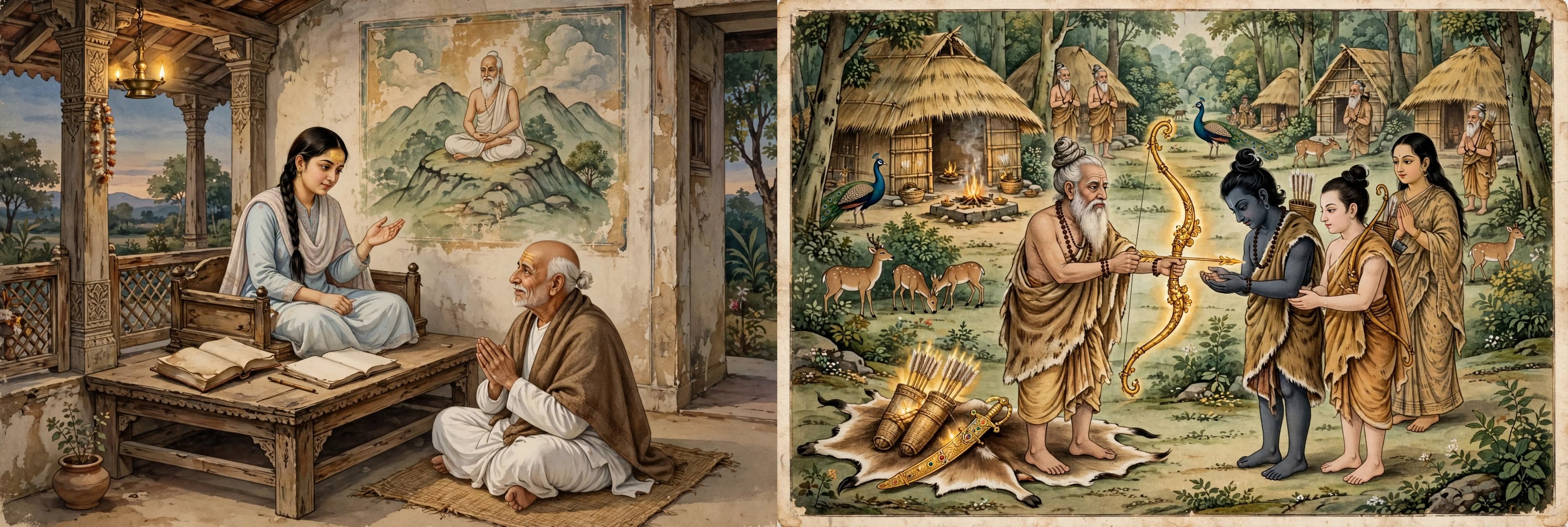
तस्यासीनं नगस्याग्रे मलयस्य महौजसम्।
द्रक्ष्यथादित्यसङ्काशमगस्त्यमृषिसत्तमम्॥
VALMIKI RAMAYAN
You will behold the supreme sage Agastya, seated on the peak of the Malaya mountain, possessing great radiance and shining like the sun.
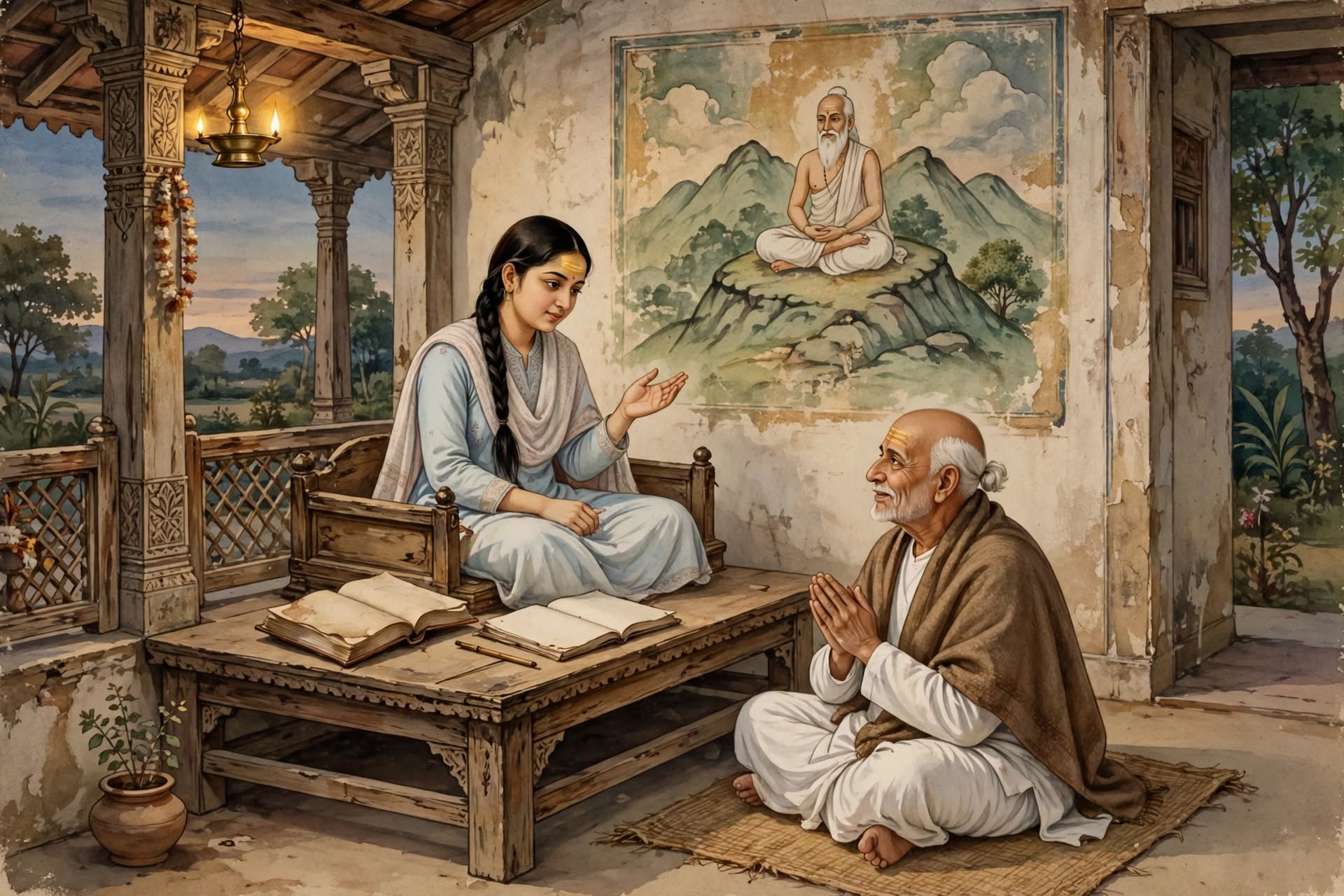
Introduction\nThird day evening. The same verandah, the same evening lamp, from where the conversation had begun three days ago. But today the seats had changed. Acharya Agastya sat below on a mat, and he had seated Apala on his vyasa-seat (teacher's seat). Apala sat with hesitation, with the Valmiki Ramayana and her own manuscript open in front of her.\nApala: Acharya-ji, this does not feel right. Me on your seat?\nAcharya: Do you remember what I said on the first day? About the story of the ancestors hanging upside down?\nApala: (Softly) If knowledge does not reach the next generation, tradition hangs upside down.\nAcharya: So today is the day to pay off that debt. For three days you asked questions, today you will tell the story, and I will ask questions. And be careful. If you miss even a bit the difference between what is in the text and what is your interpretation, I will catch it.\nApala: (With a smile, but seriously) As you command, Acharya-ji. So I will start with Ram.
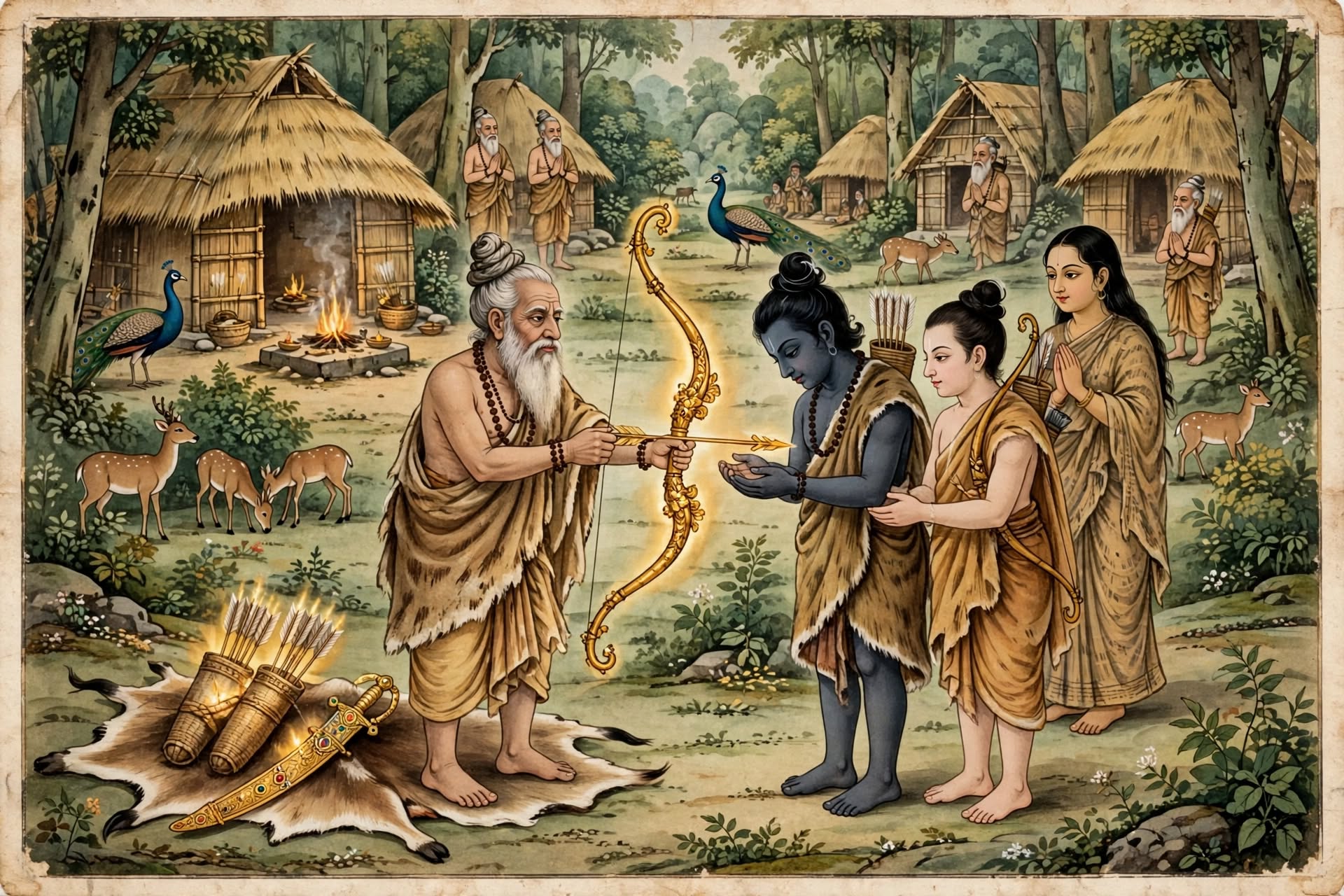
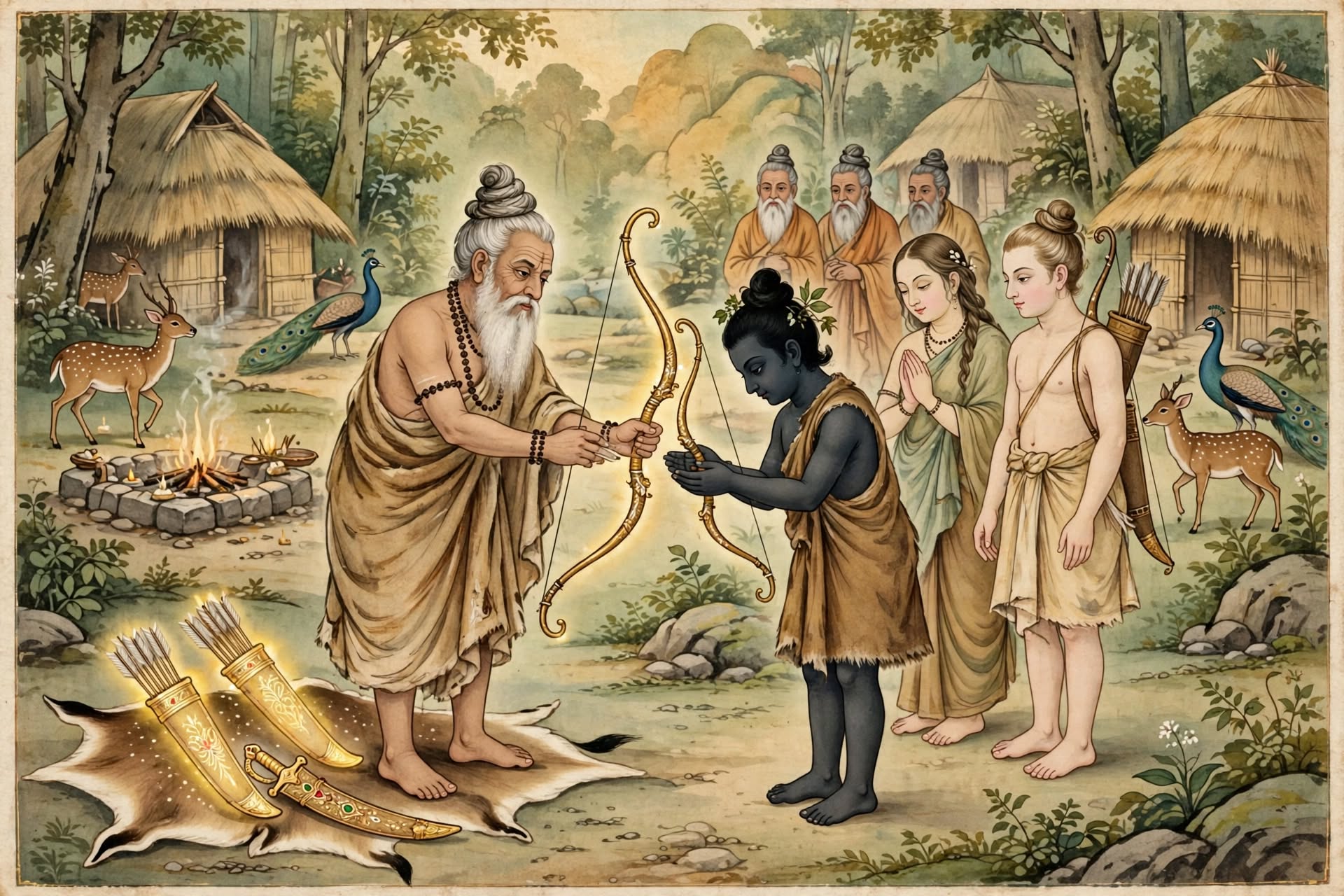
Question 1: Where did Ram meet Agastya?\nApala: Valmiki Ramayana, Aranya Kanda. While wandering in Dandakaranya during exile, Ram, Sita, and Lakshmana first reach the hermitage of Agastya's brother. There, in Canto 11, Ram narrates the story of Ilvala and Vatapi to Lakshmana. As you said on the first day, Ilvala used to assume the guise of a rishi and speak Sanskrit in the Ramayana, and in the end, he gets reduced to ashes by just a single glance of Rishi Agastya.\nAcharya: Ram himself narrates this story. What does that mean?\nApala: (Thinking a little) That this story was already famous at the time of Ram. Agastya had already become a legend. Or Ram knew his glory even before meeting him.\nAcharya: Good. Go on.\nApala: In Canto 12, Ram reaches Agastya's hermitage. Agastya gives three divine items to Ram: Vishnu's bow, which was made by Vishwakarma, two quivers that never run out, and a golden sword. And he says that it was with these very weapons that Vishnu had destroyed the asuras earlier.\nAcharya: Now the deeper meaning. A rishi, an ascetic, why would he give weapons? What does he have to do with arms?\nAcharya-ji, I feel... A rishi himself does not fight a war, but he equips the one who fights for dharma. Knowledge and power are separate, but they go together. The guru gives direction, the disciple performs the action.\nAcharya: And is this your interpretation, or the text's?\nApala: (Laughing) Mine, Acharya-ji. The text only says that he gave the weapons.\nAcharya: (Pleased) Well done.
Question 2: How did Sugriva give Agastya's "address"? Apala: This is my favorite part, Acharya ji. Kishkindha Kanda, Sarga 41. To search for Sita, Sugriva sends the monkey-army in four directions. A squad led by Angad with Hanuman, Jambavan, and Nila goes in the southern direction, because Ravana had gone toward the south. Sugriva explains the entire route to them, as if drawing a map. In verses 14 to 17: First, the divine Kaveri river with pure water will come. Then the Malaya mountain filled with sandalwood forests. And on its peak: तस्यासीनं नगस्याग्रे मलयस्य महौजसम्। द्रक्ष्यथादित्यसङ्काशमगस्त्यमृषिसत्तमम्॥ "You will have the darshan (vision) of the most radiant, sun-like, supreme sage Agastya, seated on the peak of that Malaya mountain." And Sugriva gives a special instruction: Only after obtaining the permission of that Mahatma, leave the mountain and cross the Tamraparni river filled with crocodiles. Acharya: Where is this Malaya mountain today? Apala: At the very southern end of the Western Ghats, on the border of Tamil Nadu and Kerala. Today it is called Agastyamalai or Podhigai. And the Tamraparni river originates right from there. Acharya: So what do these verses prove? Apala: Three things, Acharya ji. First, geography: Sugriva's sequence—Kaveri, then Malaya, then Tamraparni, then the ocean—matches today's map. This means at the time of Valmiki, Agastya was already associated with the Podhigai mountain of the Tamil region. Second, direction: Agastya is the gatekeeper of the southern gate. One cannot proceed further without his permission. And this morning we saw, in the sky too he is the protector of the southern horizon. On earth at the Malaya peak, in the sky at the southern horizon, at both places Agastya is the symbol of the southern direction. Third, time: At the time of the Ramayana, Agastya is settled even beyond the Vindhyas, far away in the south. The calculation of time that you spoke about this morning rests on this very detail. Acharya: And why does Sugriva call him "like the Sun"? Apala: (With enthusiasm) That is a hint of the subsequent narrative! Because it is this same Agastya who later teaches the worship of the Sun to Rama.
Question 3: Why was the [[Adityahrudaya]] (Heart of the Sun) given? Apala: Yuddhakanda (Canto of War), Sarga 105. In some editions, 107. The final battle with Rama. Rama is tired, worried, and facing Ravana who stands ready for battle once again. At that time, Agastya, who has come along with the gods to watch the battle, approaches Rama and says, "O Rama, listen to this secret hymn by which you will conquer all enemies in battle," and teaches Rama the [[Adityahrudaya]] hymn (stotra), the praise of the heart of the Sun. Acharya: Now my difficult question. The southern star teaches the worship of the Sun. Is there no contradiction in this? Apala: (Thinking for a long time) Acharya ji, this morning you said that when the Sun rose, the star Agastya became invisible, but it had not gone anywhere. So... the star itself is not the Sun, but it guides toward the Sun. That which shows the direction in the darkness shows the path of light. Rama is tired, dejected. That is a moment of darkness. At that time, the Guru comes and says, "Awaken the Sun within you." In the darkness of despair, the Guru turns [one] toward the light. And then, just as the star disappeared in the morning, the Guru steps back, and the disciple triumphs in his own light. Acharya: (Remaining silent for a moment) Apala, I did not teach you this interpretation. Apala: (Hesitantly) Meaning, is it wrong? Acharya: No. It is indeed true. Do you understand now why you are on this seat today?
Question 4: Did Agastya create the Tamil language? Acharya: Now let us go deep into the south. What does the Tamil tradition consider Agastya to be at the Podigai mountain that Sugriva pointed out? Apala: In Tamil, he is called "Agattiyar". And tradition considers him the first preceptor of the Tamil language and grammar. According to the story, Shiva and Murugan, that is Kartikeya, taught him Tamil on the Podigai mountain, and there he composed the first Tamil grammar, "Agattiyam". He taught that grammar to twelve disciples. It is also mentioned in Tirumular's Tirumandiram that, by the command of Shiva, Agastya came from the north and settled in Podigai. Acharya: Excellent. Now a direct question, and I want a direct answer. Did Agastya write the Tamil grammar? Apala: (closing the manuscript) Acharya-ji, to give an honest answer: tradition says yes, but the evidence is weak. First, the text "Agattiyam" is lost today. Only a few scattered fragments quoted by later commentators are available. Second, the oldest available Tamil grammar is "Tolkappiyam". Its author Tolkappiyar, according to tradition, was one of the twelve disciples of Agastya. Third, the oldest written mention connecting Agastya to Tamil grammar is from the 8th century, in Nakkiranar's commentary on the text named "Iraiyanar Akapporul". That commentary states that Agastya was the president of the first Tamil Sangam, which used to convene in the submerged city of **"Then Madurai"**. And fourth, most importantly: the Sangam poems and the Tolkappiyam itself do not make a direct mention of Agastya or Agattiyam. Acharya: Then what would you say? Apala: "Agastya is worshipped as the primal preceptor of the Tamil grammatical tradition, but the oldest available grammar is by his disciple." And some Tamil scholars consider the Vedic Agastya and the Tamil Agattiyar to be different persons, that view should also be noted. Acharya: (nodding his head) This morning you doubted a fifteen-thousand-year gap. Now you yourself acknowledge the limitation. This is the maturity of a researcher.
Question 5: So where do the Sanskrit and Tamil traditions meet? Acharya: But Apala, if the evidence is weak, should we drop this connection? Apala: No, Acharya-ji. Because I found one thing very beautiful. Valmiki places Agastya on Mount Malaya, meaning Mount Podigai. And the Tamil tradition also considers that same Mount Podigai as the place where Agastya composed Tamil grammar. The northern Sanskrit epic and the southern Tamil tradition, both independently, point a finger toward the exact same mountain. It does not seem like one copied from the other. It is like two different rivers originating from the same mountain. Acharya: And a river actually originates from that mountain. Do you know that story? Apala: Tamraparni. According to the Tamraparni Mahatmya, Agastya had a garland of red lotuses. Upon having the darshan (vision) of Shiva, that garland turned into a maiden, and that maiden flowed as a river. Tamra means red like copper, Parna means leaf. Acharya: And another story like this? Apala: (Startled) Kaveri! Lopamudra became Kaveri from the Kamandalu (water pot), and the garland became Tamraparni. Wherever Agastya goes, rivers are born. The sage born from a kumbha (pot), water springs wherever he places his feet. Acharya: What did we say on the first day? Apala: "Every story of Agastya is a story of water."
Question 6: The Siddha Tradition and "The Balance of the Earth" Acharya: What is the second form of Agastya in the Tamil tradition? Apala: The Siddha tradition. Among the eighteen Siddhars of Tamil Nadu, Agastya is considered the Adi Guru (primordial guru). And it is believed that he gave Siddha medicine, the traditional medical system of the Tamil region, to Murugan. Acharya: The sage who digested Vatapi, the star of Hansodaka in Ayurveda, and the Adi Guru of medicine in the South. Do you see any similarity? Apala: Health. In all three forms, Agastya is connected with the protection of the body. Digestion, pure water, medicine. Acharya: And a folklore that everyone knows? Apala: The marriage of Shiva and Parvati. All the gods and sages gathered on Kailash, so the earth tilted toward the north. To restore balance, Shiva sent Agastya to the South. Agastya alone was as heavy as the entire assembly! But Acharya-ji, I could not find a specific Purana chapter for this story. So I would call it an oral and temple tradition. Acharya: Fair. And the deeper meaning? Apala: This morning you said that researchers have noted one thing: many of Agastya's stories are about balancing the earth and about the north and south directions. Bending the Vindhya, balancing the earth, becoming the guardian of the southern gate. It is as if all the stories say: if knowledge accumulates in one place, the earth tilts. It must be spread.
Question 7: Was "Agastya" a single person? Acharya: The last question, and the deepest. Agastya in the Rigveda. In the Mahabharata. In the Ramayana. In the Puranas. In the Tamil Sangam. In Java. Thousands of years, thousands of kilometers. Are all of these the exact same Agastya? Apala: (A long silence) Acharya ji, I think... no. Acharya: Then? Apala: "Agastya" is perhaps more of a tradition or a title than a single person. Just as "Vyasa" was not one, but many. Just as a "Shankaracharya" still sits on the peeth (seat) today. That name belongs not to a person, but to a mission. And Rupa Bhati's suggestion also points in this very direction, which you mentioned this morning: "Agastya" was a community of people that kept moving south, following the southward-shifting star. In the Tamil tradition too, the idea of "multiple Agastyas" is found. Acharya: So what is the function of that title? Apala: (Flipping through the pages of her notebook) What I noted down in three days is this: To connect the North and the South. To connect the Vedas and Tamil. To connect the sky and the earth. To connect asceticism and the householder life. And wherever they went, to make knowledge flow like water. Acharya: (Standing up, folding his hands before Apala) Then Apala, today an "Agastya" is sitting in this verandah as well. Apala: (Standing up in a start) Acharya ji, you... Acharya: I am not talking about myself, my child.
Conclusion: The message hidden in the metaphor (Acharya ji spoke while pouring oil into the lamp.) Acharya: The essence of three days, in your words. Make a table. Apala: (Reading from her notebook) Narrative External Form Inner Message Born from a pot Sage from a pot Light + water = life Upside-down ancestors Hanging ancestors The debt of passing knowledge to the next generation Lopamudra's condition Demand for ornaments Protection of penance, balance of duty and desire Righteous kings Empty treasury No one can take away the rights of the subjects VATAPI Digest the demon Jatharagni (digestive fire); digesting a flaw from its root A single son One equal to a thousand Quality, not quantity Rigveda 1.179 Dialogue of a couple The rational voice of a woman; penance and householder life together Hadi Vidya Lopamudra's mantra Female guru; From "K" to "Ha", Shabdabrahman (the divine sound) Kaveri, Tamraparni Wife and necklace becoming rivers Knowledge should not remain confined, it should flow Samudrapana Drank the ocean End of the monsoon; destruction of the poisons of rain; contentment dries up greed Vindhya The bowed mountain Bowing of ego; North-South bridge Agastya Star The southern star Astronomy-almanac, health, time-calculation Nahusha Kick and fall Intoxication of power; memory of a comet Sugriva's map Sage on Malaya Gatekeeper of the South; proof of geography Aditya Hridayam Hymn in war Turning towards guru's light in despair Agattiyar Primeval guru of Tamil Confluence of Vedas and Tamil Acharya: And the essence of all this in a single sentence? Apala: "Our ancestors knew that principles are forgotten, but stories are remembered." So they wove astronomy, Ayurveda, politics, and self-knowledge, everything into stories. When my grandmother used to say "Vaatapi jeerno bhava" after meals, it was a living link to thousands of years of ancient knowledge. And she didn't even know it.
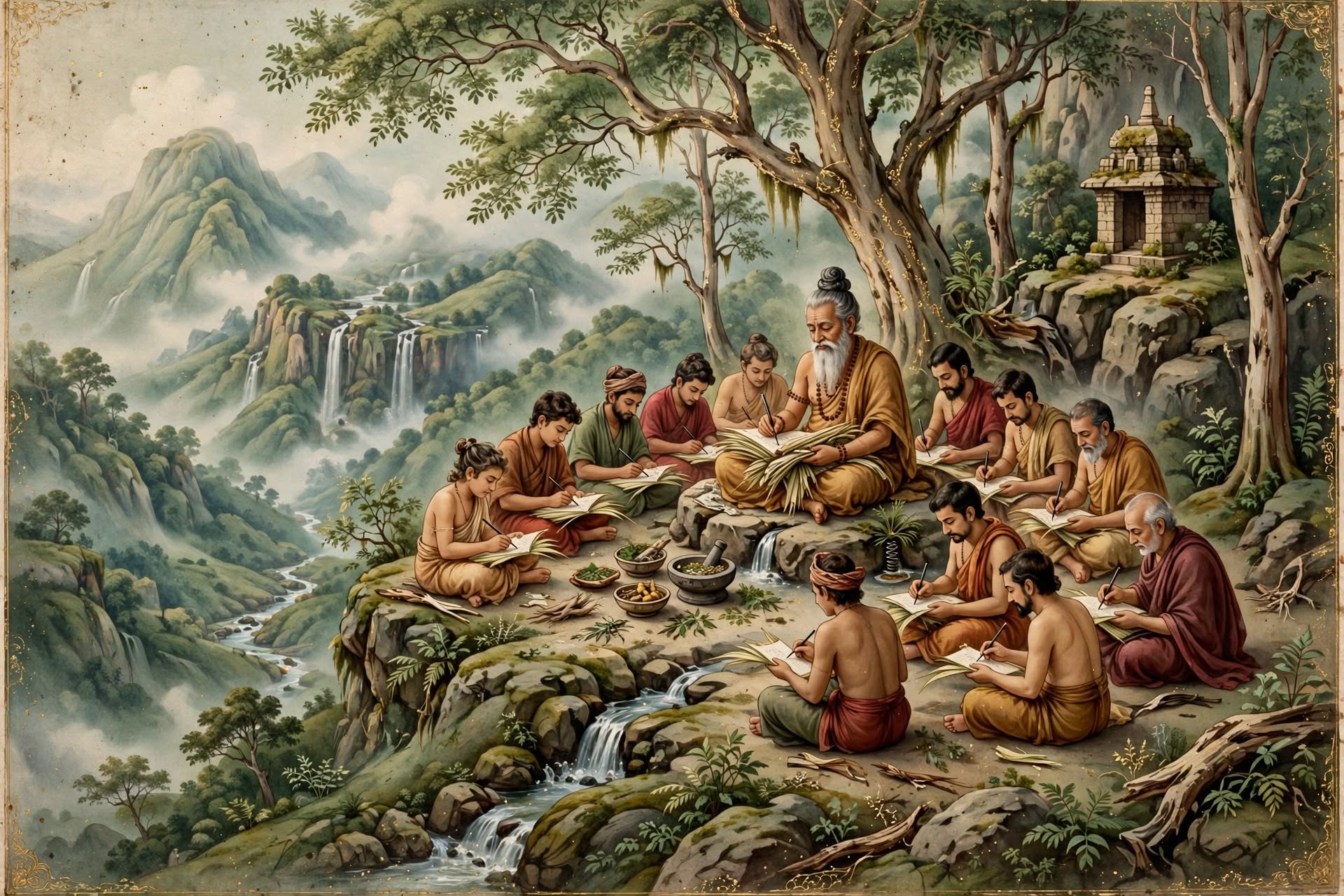
Conclusion Night had fallen. The aroma of food was wafting from the pathshala's kitchen. The Acharya stood up. Acharya: One last thing, Apala. Do you remember the name of Lopamudra and Agastya's son? Apala: Dridhasyu. But people called him Idhmavaha, because he brought samidh (sacred sacrificial twigs) for his father's yajna. The one who kept the fire of the yajna burning. Acharya: Tomorrow morning there is a class of young children at the pathshala. You will take that class. Apala: Me? What should I teach? Acharya: (With a smile) The story of Vatapi. But don't tell the children the esoteric meaning (gudhartha), just tell the story. They will find the esoteric meaning themselves when they grow up, just as you found it. You just bring the samidh, the fire will ignite on its own. Apala did not say anything. She held the manuscript close to her chest and bowed to the Acharya. At night after dinner, as everyone was beginning to get up, Apala saw that a young student sitting opposite was rubbing his stomach and asking his friend, "What does the Acharya keep saying everyday? Who is Vatapi?" Apala smiled. Three days ago, she had asked this exact question. She went and sat beside that child, and said: "He was a demon. And there was a sage who digested him. But to understand that story, we will have to start from the very beginning, with a pot..."
\u0964 \u0907\u0924\u093f \u0905\u0917\u0938\u094d\u0924\u094d\u092f-\u0905\u092a\u093e\u0932\u093e \u0938\u0902\u0935\u093e\u0926\u0903 \u0938\u0902\u092a\u0942\u0930\u094d\u0923\u0903 \u0964
References of this part Subject Original Source Rama narrates the tale of Ilvala and Vatapi Valmiki Ramayana, Aranya Kanda, Sarga 11 Divine weapons Valmiki Ramayana, Aranya Kanda, Sarga 12 Sugriva: Kaveri, Malaya, Agastya, Tamraparni Valmiki Ramayana, Kishkindha Kanda 4.41.14–17 Adityahrudaya Valmiki Ramayana, Yuddha Kanda, Sarga 105 (107 in some editions) First Sangam, Agattiyam Iraiyanar Akapporul, Nakkirar's commentary (8th century) Tolkappiyam Oldest surviving Tamil grammar In Podhigai by Shiva's command Thirumoolar, Thirumandiram Origin of Tamraparni Tamraparni Mahatmya Siddha tradition and medicine Tamil Siddha tradition Shiva-Parvati marriage, balancing of the earth Oral and temple tradition (specific Puranic chapter not found) "Agastya" as a collective group Rupa Bhaty, Indica Today (2021) and preprint (2022) Bibliography of the entire series Vedic: Rigveda 1.165–1.191 (Hymns of Agastya), 1.179 (Dialogue between Lopamudra and Agastya), 1.191 (Venomous creatures and the sun), 7.33.10–13 (Birth legend), 8.91 (Rishika Apala); Brihaddevata 4.57–59; Tripura Upanishad; Taittiriya Samhita and Shatapatha Brahmana (Threefold debts). History: Mahabharata, Vana Parva 96–99, 101–105, 130.5; Udyoga Parva and Anushasana Parva 100 (Nahusha). Valmiki Ramayana, Ayodhya Kanda 2.11; Aranya Kanda 11–12; Kishkindha Kanda 41; Yuddha Kanda 105/107. Purana and Tantra: Brahmanda Purana, Lalitopakhyana (Chapters 38–39); Skanda Purana, Kashi Khanda Purvardha 1–6 and Kaveri Mahatmya; Matsya Purana; Tantraraja Tantra; Vamakeshvara Tantra. Astrology, Ayurveda, Poetry: Varahamihira, Brihat Samhita 12; Vagbhata, Ashtanga Hridayam, Sutrasthana 3.52; Sushruta Samhita; Kalidasa, Raghuvamsha 4.21; Tulsidas, Ramcharitmanas, Kishkindha Kanda. Tamil and Southeast Asia: Iraiyanar Akapporul (Nakkirar's commentary); Tolkappiyam; Thirumandiram; Tamraparni Mahatmya; Javanese Agastya-Parva (11th century). Inscriptions: Pallava Kuram copper plates (7th century, "Vatapikonda"). Modern Research: K. D. Abhyankar, Indian Journal of History of Science; Rupa Bhaty, "The Etymology of Agastya is Astronomical in Nature" (Preprint, 2022) and "Revisiting Agastya-Vindhyā Lore", Indica Today (2021); Nilesh N. Oak, The Historic Rama; Dr. Raja Ram Mohan Roy, Refutation of Oak's calculations (10 parts); R. N. Iyengar and K. C. Hari; "Vega and Canopus: Rare Epoch of Two Bright Pole Stars"; S. Das Gupta, arXiv:1704.00722; Abel Bergaigne, La Religion védique. Online Reading: valmiki.iitk.ac.in (IIT Kanpur, Ramayana with verse meanings); wisdomlib.org (Mahabharata, Skanda Purana, Lalitopakhyana, Brihat Samhita); sacred-texts.com (Vana Parva).
Leave a reflection
Your name and words appear below. Your email is kept private and never shown.